



 WOMEN IN TECH
WOMEN IN TECH
WOMEN IN TECH
WOMEN IN TECH

Open Source Day is one of the most popular events at the Grace Hopper Celebration of Women in Computing. This year, a day-long open-source hackathon was devoted to participants developing open-source projects for humanitarian causes.
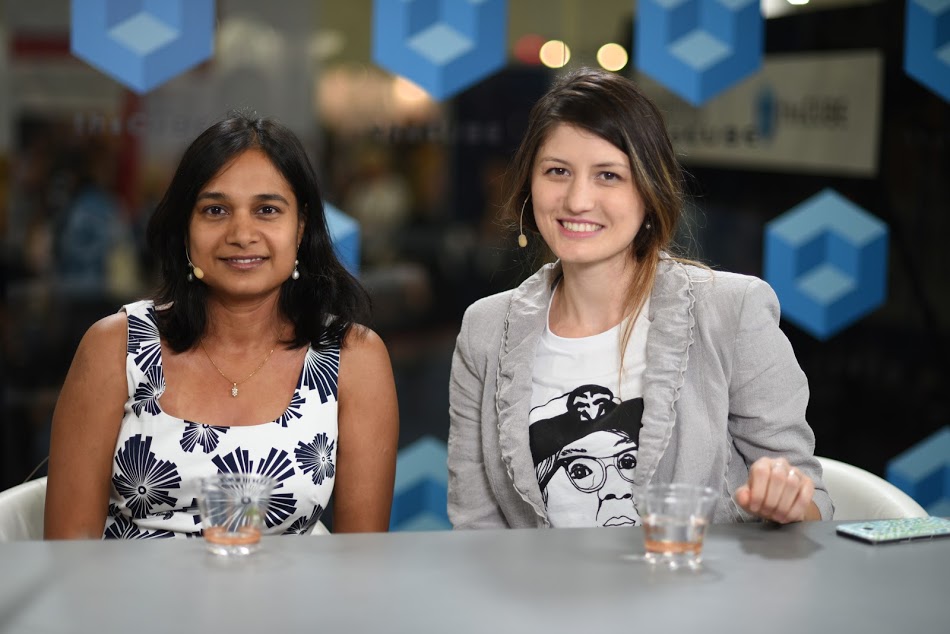
Neetu Jain, product manager at SoftLayer, an IBM Company, and Daniela Dorneanu, solution developer and product trainer at Appway, joined Rebecca Knight (@knightrm), co-host of theCUBE, from the SiliconANGLE Media team, during the Grace Hopper event to discuss the mission of Open Source Day and the goal of the hackathon for humanity.
Knight kicked off the conversation by asking about how the hackathon was organized.
“We … called all the organizations we knew that were passionate about open-source projects for humanitarian causes. We have KloudData participating with us; they are working on a project … which tries to identify human traffic victims using data science on chat bots. They … analyze the chatting data on the dark web, and they try to match patterns; pictures posted, communications posted. [Then they give that data] to the relevant [authorities],” said Jain.
She spoke of another project, called Women’s Peer-to-Peer Network. In some areas of the world, women don’t have a voice outside of the home and cannot communicate in standard ways, so the project uses mobile phone repeaters to create a “shadow network” for women to communicate with each other.
There’s a perception that hackathons are very competitive, with every software developer for themselves. Knight asked if that was true at Grace Hopper.
Dorneanu said that, to the contrary, “Hackathons involve a lot of cooperation … you can’t solve it by yourself; you have to collaborate. This is a great start for many women; maybe they didn’t have the courage [to participate] in an all-male environment.”
According to Jain, “I was an open-source mentor last year, and I helped someone to learn Git … this year, she came up to me and thanked me, and she’s teaching Git at her university, and now she’s teaching Git upstairs in the hackathon.”
People start out as learners, and then they instruct what they have learned to others, Jain explained.
Watch the complete video interview below, and be sure to check out more of SiliconANGLE and theCUBE’s coverage of the Anita Borg Institute’s Grace Hopper Celebration of Women in Computing.
… We’d like to tell you about our mission and how you can help us fulfill it. SiliconANGLE Media Inc.’s business model is based on the intrinsic value of the content, not advertising. Unlike many online publications, we don’t have a paywall or run banner advertising, because we want to keep our journalism open, without influence or the need to chase traffic.The journalism, reporting and commentary on SiliconANGLE — along with live, unscripted video from our Silicon Valley studio and globe-trotting video teams at theCUBE — take a lot of hard work, time and money. Keeping the quality high requires the support of sponsors who are aligned with our vision of ad-free journalism content.
If you like the reporting, video interviews and other ad-free content here, please take a moment to check out a sample of the video content supported by our sponsors, tweet your support, and keep coming back to SiliconANGLE.






