



 CLOUD
CLOUD
CLOUD
CLOUD
CLOUD

Six years after its initial release, the open-source cloud computing platform OpenStack continues to gain steam.
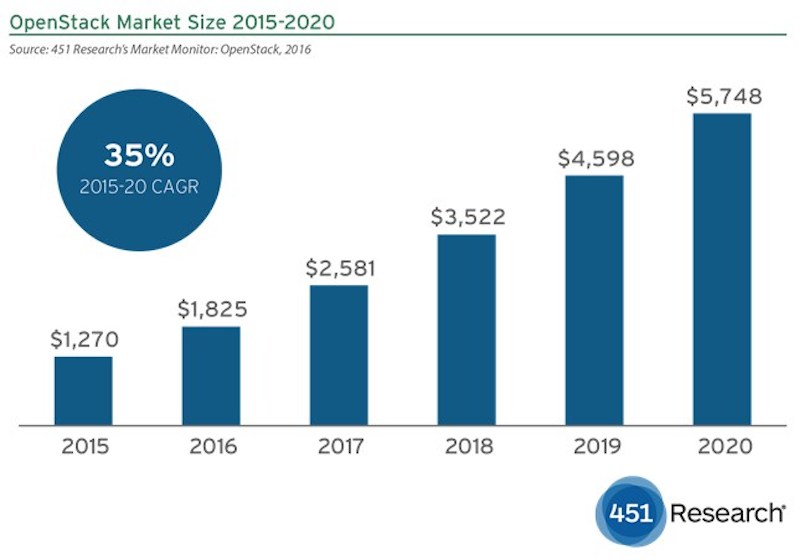
A new report from 451 Research predicts that the companies working to commercialize the project will generate total revenues of $1.8 billion this year, $2.5 billion in 2017 and north of $5 billion annually by the end of the decade.
The firm expects much of this growth to occur on the back of increasing demand from everyday enterprises, which currently use OpenStack mainly to support non-critical internal workloads such as test and development environments. By 2019, however, 451 Research sees private cloud deployments eclipsing the service provider segment as the largest source of revenue in the project ecosystem.
That’s good news for companies such as Mirantis Inc. that sell commercial versions of the platform designed to simplify on-premise implementations. In fact, today’s report specifically singles out distributors as one of the supplier groups that can expect to see a “revenue uptime” thanks to the growing popularity of OpenStack.
According to an April survey from the foundation that oversees the platform’s development, the main reason why organizations are flocking to the likes of Mirantis is a desire to cut operating expenses. Its findings are reaffirmed by a recent cost analysis conducted by 451 Research that found on-premises OpenStack deployments are cheaper to operate than public cloud deployments if there are more than 400 virtual machines per administrator.
The firm expects that organizations will take advantage of the platform’s cost efficiency and feature set in a variety of use cases, from powering software-defined networks to supporting connected devices. But the OpenStack ecosystem will have to overcome several challenges if it is to hit the $5 billion revenue mark by 2020.
One of the biggest threats that 451 Research sees to the project’s continued success is Docker, which currently serves a mostly complementary role but is emerging as an increasingly attractive substitute in many scenarios. The report warns that “persistent attention to containers and their management threatens to eclipse OpenStack, similar to how OpenStack surpassed its rival CloudStack in mindshare and then market share.”
The project’s backers are working hard to avoid that fate. Mirantis, for instance, recently launched an effort to package the core components of OpenStack into Docker instances so that they can be deployed and managed in a more modular fashion. It followed up the move a few weeks ago by acquiring a startup called TCP Cloud SA that has found a way of applying the same approach to streamlining updates.
… We’d like to tell you about our mission and how you can help us fulfill it. SiliconANGLE Media Inc.’s business model is based on the intrinsic value of the content, not advertising. Unlike many online publications, we don’t have a paywall or run banner advertising, because we want to keep our journalism open, without influence or the need to chase traffic.The journalism, reporting and commentary on SiliconANGLE — along with live, unscripted video from our Silicon Valley studio and globe-trotting video teams at theCUBE — take a lot of hard work, time and money. Keeping the quality high requires the support of sponsors who are aligned with our vision of ad-free journalism content.
If you like the reporting, video interviews and other ad-free content here, please take a moment to check out a sample of the video content supported by our sponsors, tweet your support, and keep coming back to SiliconANGLE.






