



 INFRA
INFRA
INFRA
INFRA
INFRA

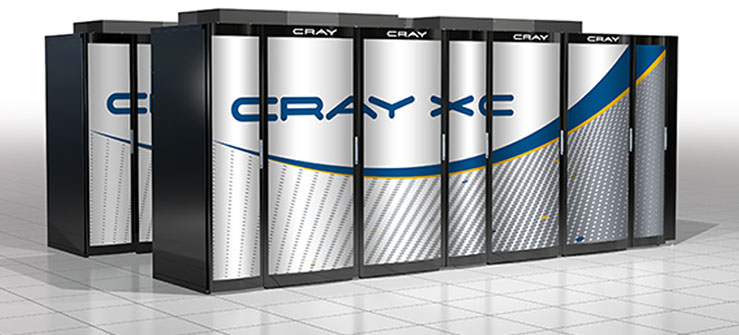
More than 30 years after selling its first supercomputer, Cray Inc. continues to push the envelope on processing power.
The company unveiled a new data crunching system at the SC16 computing event in Utah today that is the first of its kind to incorporate Nvidia Corp.’s latest-generation P100 accelerators. Based on the chip maker’s 16-nanometer Pascal architecture, the series is touted as the fastest in the world. Each unit can provide 4.7 teraflops of performance when carrying out calculations with double-precision numbers (numerical values that take up eight bytes) and more than twice that for single-precision operations.
The result is that a single cabinet in the XC50, as Cray calls its new platform, is capable of delivering more than a petaflop of computational capacity when operating at peak speed. For perspective, it would take about 93 such cabinets to match the speed of the world’s fastest supercomputer, China’s Sunway TaihuLight system. Supercomputer ranking site TOP500 states that the XC50 has a maximum capacity of 500 petaflops.
So-called petascale computing is intended to tackle the most demanding computational tasks, such as modeling weather. Cray said the system also will be useful in artificial intelligence, in particular the branch of AI called deep learning that is responsible for big advances recently in speech and image recognition. Nvidia’s graphics processing units that are used in the new machine have become the standard chips in servers used to do deep learning.
The system’s scalability is owed largely to homegrown Aries router chips that Cray has been shipping with its XC systems since the series launched in 2012. They enable cabinets to communicate at the rapid speed that high-performance computing workloads require. The new XC50 also inherits the company’s DataWarp storage acceleration technology, its management software and support for Intel Corp.’s latest-generation Broadwell processors. Organizations that aren’t satisfied with Nvidia will have the option of fitting their deployments with the chip giant’s Xeon Phi accelerators instead of P100s.
The first adopter of the XC50 is the Swiss National Supercomputing Centre, which is currently in the process of converting its existing XC30 deployment into the new platform. Dr. Thomas C. Shulthess, the director of the institute, said in a prepared statement that the upgrade will “significantly accelerate our computational research capabilities, allowing our users to perform more advanced, data-intensive simulations, visualizations and data analyses across a wide array of scientific studies.”
… We’d like to tell you about our mission and how you can help us fulfill it. SiliconANGLE Media Inc.’s business model is based on the intrinsic value of the content, not advertising. Unlike many online publications, we don’t have a paywall or run banner advertising, because we want to keep our journalism open, without influence or the need to chase traffic.The journalism, reporting and commentary on SiliconANGLE — along with live, unscripted video from our Silicon Valley studio and globe-trotting video teams at theCUBE — take a lot of hard work, time and money. Keeping the quality high requires the support of sponsors who are aligned with our vision of ad-free journalism content.
If you like the reporting, video interviews and other ad-free content here, please take a moment to check out a sample of the video content supported by our sponsors, tweet your support, and keep coming back to SiliconANGLE.






