



 CLOUD
CLOUD
CLOUD
CLOUD
CLOUD

Hewlett Packard Enterprise Co.’s cloud business strategy has recently undergone many changes as the company seeks new and inventive ways to grow the business. The play has been for HPE, rather than operating its own public cloud, to work with AWS, Azure, Google and other public cloud providers to develop hybrid cloud environments for enterprises. To this end, HPE folded cloud into its infrastructure group, and it is working on expanding its private and managed cloud efforts, according to Jay Jamison, VP of strategy, Software Defined and Cloud Group, at Hewlett Packard Enterprise Co.
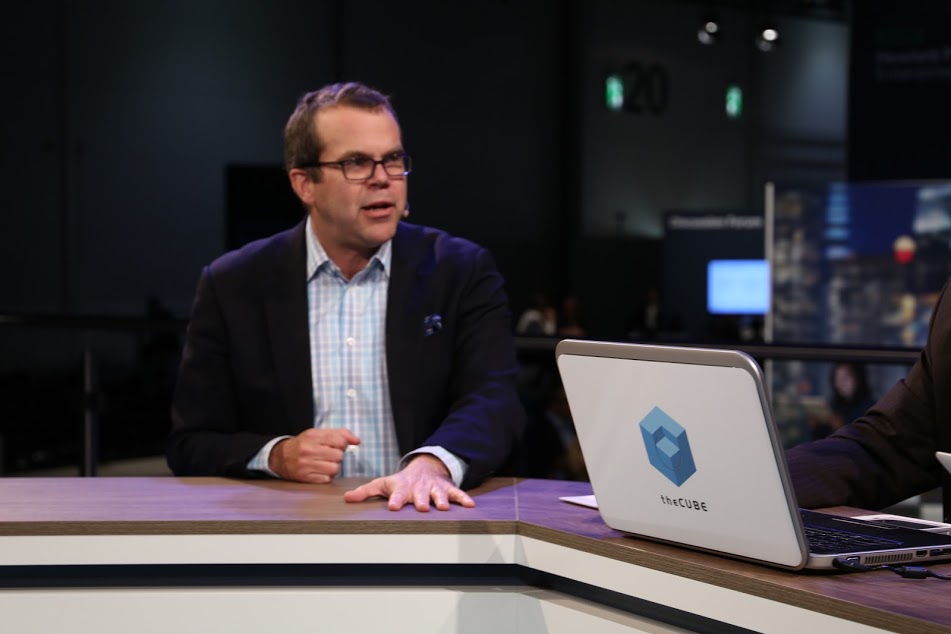
Jamison talked with Dave Vellante (@dvellante) and Paul Gillin (@pgillin), co-hosts of theCUBE*, from the SiliconANGLE Media team, during HPE Discover EU, held in London. (*Disclosure below) They discussed HPE’s mission to help clients navigate the hybrid cloud world, as well as what resources and services they provide to its customers.
“Our mission is to help enterprises get solutions where we make hybrid IT simpler,” said Jamison. HPE customers who are moving to cloud usually have many thousands of applications to move, of differing technologies; that can be quite confusing, and so enterprises are looking to them for help, he explained. HPE is looking to be the first and trusted partner to its customers in this very diverse and fast-evolving market.
Jamison pointed out that cloud isn’t a one-size-fits-all model for any customer in the enterprise space. HPE wants to provide a wide and comprehensive breadth of solutions that spans the partners and the technologies that they want, and a way to consume it.
“We acknowledge that in a hybrid world, when customers think about cloud, they’re thinking about a set of resources that span from on-prem to off-prem,” said Jamison. He went on to explain that HPE’s strategy is to say to its customers: “We have great infrastructure that will land on-prem, such as our composable synergy stack, and then the management layers that we’re delivering will manage that, but will also manage off-prem the workloads that run in an Azure, Amazon or in our cloud.”
HPE sees that customers have workloads running in a public cloud, and they have other, traditional, mission-critical workloads that have been running for years on-prem, Jamison explained. Those workloads have no reason to move anywhere — to a private cloud or anywhere else. So HPE thinks how it can deliver great hybrid cloud capabilities, as well providing the delivery of infrastructure and platform services at the software layer, and pairing it up with hardware.
Watch the complete video interview below, and be sure to check out more of SiliconANGLE and theCUBE’s coverage of HPE Discover EU. (*Disclosure: HPE and other companies sponsor some HPE Discover EU segments on SiliconANGLE Media’s theCUBE. Neither HPE nor other sponsors have editorial control over content on theCUBE or SiliconANGLE.)
… We’d like to tell you about our mission and how you can help us fulfill it. SiliconANGLE Media Inc.’s business model is based on the intrinsic value of the content, not advertising. Unlike many online publications, we don’t have a paywall or run banner advertising, because we want to keep our journalism open, without influence or the need to chase traffic.The journalism, reporting and commentary on SiliconANGLE — along with live, unscripted video from our Silicon Valley studio and globe-trotting video teams at theCUBE — take a lot of hard work, time and money. Keeping the quality high requires the support of sponsors who are aligned with our vision of ad-free journalism content.
If you like the reporting, video interviews and other ad-free content here, please take a moment to check out a sample of the video content supported by our sponsors, tweet your support, and keep coming back to SiliconANGLE.






