



 EMERGING TECH
EMERGING TECH
EMERGING TECH
EMERGING TECH

An inquiry by the U.S. National Transportation Safety Board following the crash of Facebook Inc.’s Aquila drone back in June has determined the cause: wind and software failure.
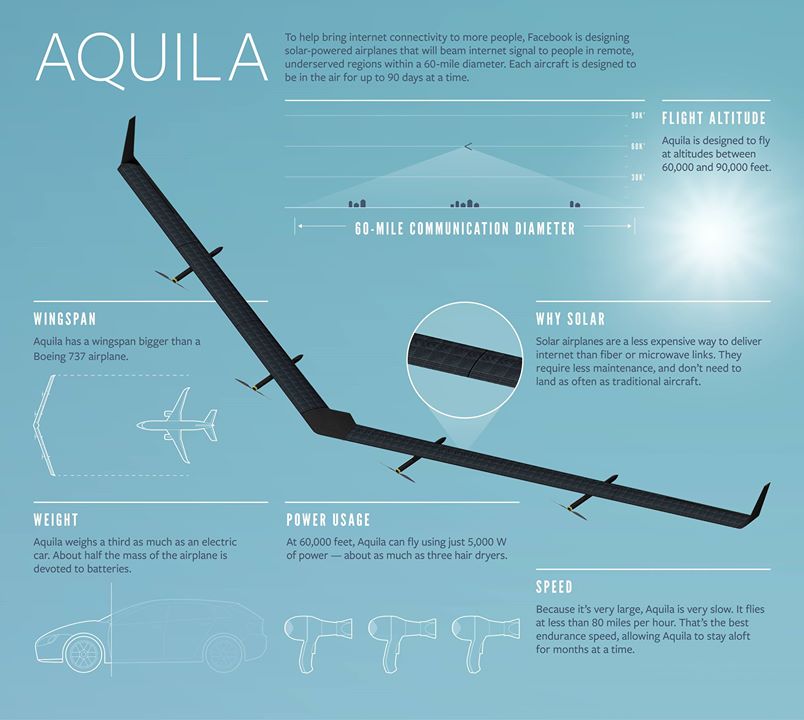
The maiden flight of the solar-powered Aquila drone, which has a wingspan roughly equivalent to a Boeing 737, was initially praised by Facebook as having been a success but was subsequently revealed to have not been so successful after all after the NTSB announced its inquiry in November.
At the time the inquiry was announced, it was disclosed that the drone had suffered from a “structural failure” before it landed on June 28 and was classified as an accident, as the damage was substantial. No one was injured as a result of the failure, and there was no damage to the ground.
According to the report findings, during final approach the aircraft encountered an increasing amount of turbulence and wind speeds of up to 12 to 18 knots, causing the aircraft to experience reasonable turbulence above that expected by the test. At 20 feet above the ground, a wind gust tipped the aircraft above the glide path, that is the course followed by the aircraft when descending for a landing.
The autopilot is said to have responded by lowering the nose of the aircraft to reestablish itself on the glide path, then pushing upward the elevons, a type of aircraft control surface. A combination of high airspeed, up elevon and low angle of attack resulted in increased downward lift on the outer wing panels. That in turn caused a load that exceeded its structural limit and resulted in the failure of the right wing.
Ultimately the NTSB found that the “a structural failure of the wing as a result of exceeding the airspeed envelope due to wind gusts which were beyond the capabilities of the autopilot. Contributing to the accident was an insufficient amount of drag to track the glide slope in the presence of atmospheric disturbances.”
The short, plain English version: The gigantic drone wasn’t programmed properly to deal with wind.
Facebook told Recode that it is working on an updated version of the Aquila drone, with a new kind of brake system that will help the autopilot land more smoothly.
… We’d like to tell you about our mission and how you can help us fulfill it. SiliconANGLE Media Inc.’s business model is based on the intrinsic value of the content, not advertising. Unlike many online publications, we don’t have a paywall or run banner advertising, because we want to keep our journalism open, without influence or the need to chase traffic.The journalism, reporting and commentary on SiliconANGLE — along with live, unscripted video from our Silicon Valley studio and globe-trotting video teams at theCUBE — take a lot of hard work, time and money. Keeping the quality high requires the support of sponsors who are aligned with our vision of ad-free journalism content.
If you like the reporting, video interviews and other ad-free content here, please take a moment to check out a sample of the video content supported by our sponsors, tweet your support, and keep coming back to SiliconANGLE.






