



 EMERGING TECH
EMERGING TECH
EMERGING TECH
EMERGING TECH

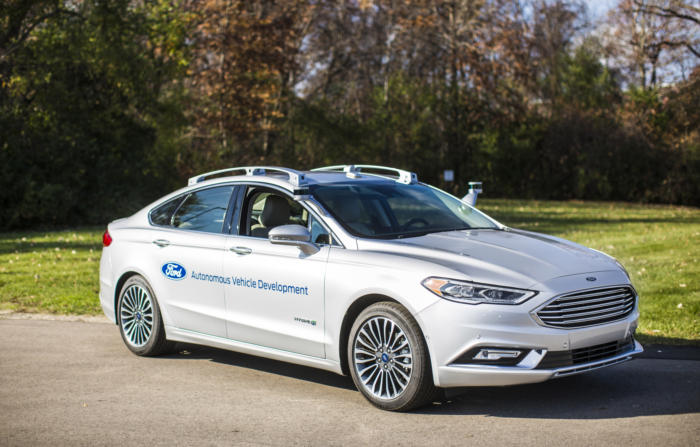
Ford Motor Co. Wednesday unveiled its latest Fusion autonomous vehicle complete with more processing power that brings it closer to being ready for production.
Included in the new car are adjustments to the sensor technology to allow the car to better see what’s around it, along with new Light Detection And Rangings, or LiDAR, sensors that are described as having a sleeker design and more targeted field of vision. The number of LiDAR sensors has also decreased from four to two while delivering the vehicle more data that its predecessor.
Interestingly, given many self-driving vehicles often sport ugly boxes on the roof, Ford has rather ingeniously built the camera units into the luggage rack of the vehicle, delivering a much more standard vehicle look. According to Ford Chief Program Engineer Chris Brewer, the new vehicle can orient itself by comparing what its LiDAR, radar, and other sensors pick up with what Brewer describes as “mediated perception,” a process that requires the creation of high-resolution 3D maps of the environment where the autonomous car will be driving.
Those maps include everything the virtual driver system knows about the road before the car even starts driving , such as the locations of stop signs, crosswalks, traffic signals and other static objects. The car also exercises what is described as “direct perception” to interpret real-time activity, including knowing its current location and identifying the presence of other vehicles, people and obstacles such as construction zones.
All of that processing requires some serious computing power. Ford’s “autonomous vehicle brain,” located in the trunk generates a staggering 1 terabyte of data an hour , or as Brewer describes “more than the average person would use in mobile-phone data in 45 years.”
The revealing of its new self-driving car by Ford comes ahead of next week’s Consumer Electronics Show in Las Vegas which is expected to include multiple companies highlighting their latest developments in the field. It’s in line with Ford’s commitment in August this year to produce a fully autonomous car, with no steering wheel or gas or brake pedals, in commercial volumes by 2021.
… We’d like to tell you about our mission and how you can help us fulfill it. SiliconANGLE Media Inc.’s business model is based on the intrinsic value of the content, not advertising. Unlike many online publications, we don’t have a paywall or run banner advertising, because we want to keep our journalism open, without influence or the need to chase traffic.The journalism, reporting and commentary on SiliconANGLE — along with live, unscripted video from our Silicon Valley studio and globe-trotting video teams at theCUBE — take a lot of hard work, time and money. Keeping the quality high requires the support of sponsors who are aligned with our vision of ad-free journalism content.
If you like the reporting, video interviews and other ad-free content here, please take a moment to check out a sample of the video content supported by our sponsors, tweet your support, and keep coming back to SiliconANGLE.






