



 EMERGING TECH
EMERGING TECH
EMERGING TECH
EMERGING TECH

Advanced Micro Devices Inc. has finally unveiled some of the details of its next-generation Vega graphics processing unit architecture, and the new cards could provide some serious competition for Nvidia Corp., AMD’s chief rival in graphics hardware.
In an official announcement Thursday, AMD highlighted several of Vega’s advancements, including a dramatically improved geometry pipeline and an all-new pixel engine, both of which will allow the new cards to handle the heavy graphics requirements of modern 4k and virtual reality gaming.
Vega also boasts an advanced HMB2 memory architecture, which can transfer terabytes of data per second with double the bandwidth-per-pin versus the previous generation. AMD also highlighted Vega’s new compute engine, which can process multiple 8-bit, 16-bit, 32-bit or 64-bit operations in each clock cycle.
AMD and Nvidia have been clashing for years in personal computer gaming, with Nvidia’s cards typically winning out in terms of raw power while AMD’s cards offered better performance per dollar. In recent years, the immense power of modern GPUs has made them popular hardware for companies working with machine learning and other high-volume, heavy-compute tasks. Nvidia’s hardware has been especially popular for machine learning tasks, but with AMD’s new Vega architecture, Nvidia may no longer be the only GPU game in town for the enterprise.
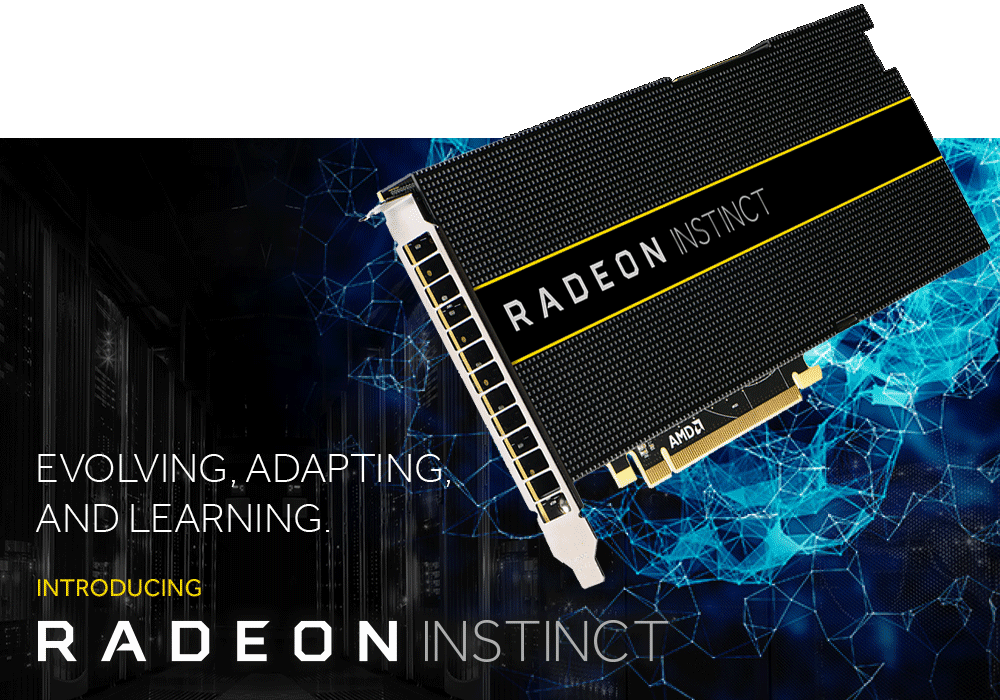
In addition to the gaming-focused Radeon RX and the creator-focused Radeon Pro, AMD will also soon launch the new Radeon Instinct GPU line, which is specifically designed with machine learning in mind. AMD noted that Vega’s new HMB2 memory architecture will be especially helpful for machine learning, as it enables the new cards to process the huge datasets involved in deep learning.
“It is incredible to see GPUs being used to solve gigabyte-scale data problems in gaming to exabyte-scale data problems in machine intelligence,” said Raja Koduri, senior vice president and chief architect at AMD’s Radeon Technologies Group. “We designed the Vega architecture to build on this ability, with the flexibility to address the extraordinary breadth of problems GPUs will be solving not only today but also five years from now. Our high-bandwidth cache is a pivotal disruption that has the potential to impact the whole GPU market.”
AMD said it will begin shipping GPU products built with the new Vega architecture sometime in the first half of 2017.
… We’d like to tell you about our mission and how you can help us fulfill it. SiliconANGLE Media Inc.’s business model is based on the intrinsic value of the content, not advertising. Unlike many online publications, we don’t have a paywall or run banner advertising, because we want to keep our journalism open, without influence or the need to chase traffic.The journalism, reporting and commentary on SiliconANGLE — along with live, unscripted video from our Silicon Valley studio and globe-trotting video teams at theCUBE — take a lot of hard work, time and money. Keeping the quality high requires the support of sponsors who are aligned with our vision of ad-free journalism content.
If you like the reporting, video interviews and other ad-free content here, please take a moment to check out a sample of the video content supported by our sponsors, tweet your support, and keep coming back to SiliconANGLE.






