



 EMERGING TECH
EMERGING TECH
EMERGING TECH
EMERGING TECH

The United States military revealed on Monday that it has successfully launched swarms of tiny surveillance drones from three F/A-18 Super Hornet fighter jets, an accomplishment that could fundamentally change the nature of battlefield reconnaissance.
The military conducted the test in October using a total of 103 Perdix drones, each of which are roughly the size of a Frisbee. Designed by scientists at the MIT Lincoln Laboratory, the Perdix drones are sturdy enough to survive being launched from the jets’ flare dispensers, which involves speeds of up to 460 miles per hour and temperatures as low as -10 degrees Centigrade (14 degrees Fahrenheit). They can also fly for more than 20 minutes at a time at speeds of nearly 70 miles per hour.
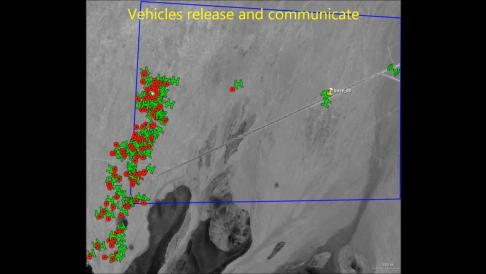
According to the Department of Defense, the Perdix drones function as a single-minded swarm rather than as a collection of individuals.
“Due to the complex nature of combat, Perdix are not pre-programmed synchronized individuals, they are a collective organism, sharing one distributed brain for decision-making and adapting to each other like swarms in nature,” William Roper, director of the Pentagon’s Strategic Capabilities Office, said in a statement. “Because every Perdix communicates and collaborates with every other Perdix, the swarm has no leader and can gracefully adapt to drones entering or exiting the team.”
In other words, drones can be destroyed by enemy combatants or other obstacles and additional drones can be launched to replace them without disrupting the rest of the swarm. The Pentagon office compares controlling the Perdix swarm to a sports coach calling out plays, with the drones deciding how best to carry out those actions. For example, an operator can order the drones to maintain a fixed position, and the drones will circle that location until given another command.
The DoD noted in its statement that the small, relatively inexpensive Perdix drones could end up taking over roles currently filled by larger, more costly drones. According to the military, the mini-drone swarms and similar projects will “empower humans to make better decisions faster” by providing real-time reconnaissance data that would be both difficult and dangerous to obtain otherwise.
The military is currently working on a new generation of Perdix drones that will be capable of even more autonomy. That could provide a big commercial opportunity: The DoD hopes to find companies that can quickly build more than 1,000 units per year.
… We’d like to tell you about our mission and how you can help us fulfill it. SiliconANGLE Media Inc.’s business model is based on the intrinsic value of the content, not advertising. Unlike many online publications, we don’t have a paywall or run banner advertising, because we want to keep our journalism open, without influence or the need to chase traffic.The journalism, reporting and commentary on SiliconANGLE — along with live, unscripted video from our Silicon Valley studio and globe-trotting video teams at theCUBE — take a lot of hard work, time and money. Keeping the quality high requires the support of sponsors who are aligned with our vision of ad-free journalism content.
If you like the reporting, video interviews and other ad-free content here, please take a moment to check out a sample of the video content supported by our sponsors, tweet your support, and keep coming back to SiliconANGLE.






