



 APPS
APPS
APPS
APPS
APPS

Sketchy ads have been a problem on the Internet for a few decades now, but according to Google Inc.’s latest Bad Ads Report, it looks like things are getting worse rather than better.
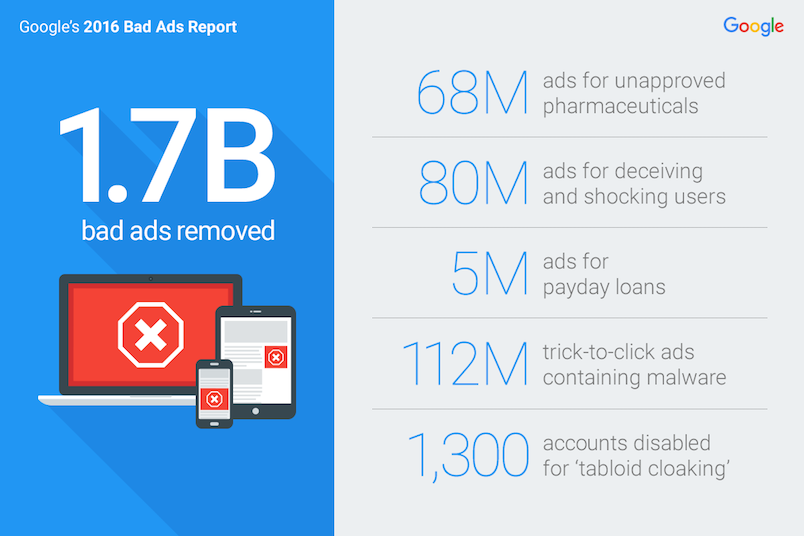
In its report, Google revealed that in 2016 it took down over 1.7 billion ads that linked to malware, scams or other harmful content. This is more than double the number of bad ads Google took down in 2015, and the company says that the continuing proliferation of bad ads is bad news for everyone.
“[Bad ads] promote illegal products and unrealistic offers. They can trick people into sharing personal information and infect devices with harmful software,” Scott Spencer, director of product management for sustainable ads at Google, said in a blog post. “Ultimately, bad ads pose a threat to users, Google’s partners, and the sustainability of the open web itself.”
Some of the ads that Google removed included ads for illegal products like pharmaceuticals, misleading ads that trick users into clicking on them and mobile ads that automatically download apps without approval. Google said that one new type of bad ad that has become increasingly common is tabloid cloakers, which are ads that masquerade as news stories.
While the dramatic rise in bad ads is troubling, Spencer notes that the increase is at least partly thanks to changes Google made to its ad policies, which banned a wider range of content from its advertising platform last year. Spencer also pointed out that the technology Google uses to catch bad ads has gotten better, allowing it to spot ads that might have slipped through before.
“We beefed up our technology so we can spot and disable bad ads even faster,” Spencer said. “For example, ‘trick to click’ ads often appear as system warnings to deceive users into clicking on them, not realizing they are often downloading harmful software or malware. In 2016, our systems detected and disabled a total of 112 million ads for ‘trick to click,’ 6X more than in 2015.”
Spencer said that keeping bad ads off of Google’s platform would be an impossible task if left to humans alone, and he explained that without automation, a human removing one ad per second would have spent 50 years taking down the number of ads that were removed by Google’s automated system.
While Spencer did not expand on how exactly Google’s ad-removing system has changed, but it has likely benefited from the company’s heavy investment in machine learning through Google Brain and DeepMind Technologies. In 2012, Google explained that its ad system uses machine learning to recognize illicit ads by analyzing both the landing pages to which those ads lead, as well as the activity of the advertiser accounts that submitted those ads.
“While we took down more bad ads in 2016 than ever before, the battle doesn’t end here,” Spencer concluded. “As we invest in better detection, the scammers invest in more elaborate attempts to trick our systems. Continuing to find and fight them is essential to protecting people online and ensuring you get the very best from the open web.”
… We’d like to tell you about our mission and how you can help us fulfill it. SiliconANGLE Media Inc.’s business model is based on the intrinsic value of the content, not advertising. Unlike many online publications, we don’t have a paywall or run banner advertising, because we want to keep our journalism open, without influence or the need to chase traffic.The journalism, reporting and commentary on SiliconANGLE — along with live, unscripted video from our Silicon Valley studio and globe-trotting video teams at theCUBE — take a lot of hard work, time and money. Keeping the quality high requires the support of sponsors who are aligned with our vision of ad-free journalism content.
If you like the reporting, video interviews and other ad-free content here, please take a moment to check out a sample of the video content supported by our sponsors, tweet your support, and keep coming back to SiliconANGLE.






