



 INFRA
INFRA
INFRA
INFRA
INFRA

Continuing its bid to become an arms dealer for the internet of things revolution, Nvidia Corp. today is overhauling its Jetson embedded edge processing platform.
The chip maker is doubling memory, storage and throughput while improving video encoding support and video capture capability in a package that draws less than 7.5 watts of power. Nvidia is targeting the market for smart devices at the edge of the network, such as image processing, speech recognition, and navigation in driver-less vehicles.
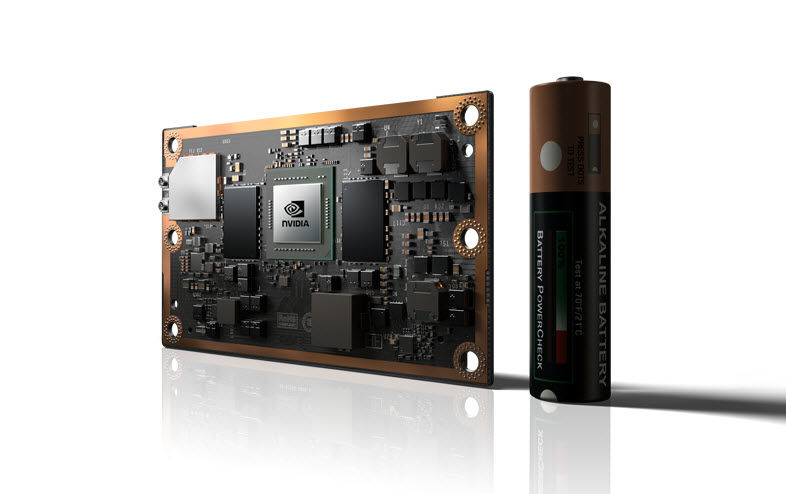
Nvidia said its Jetson TX2 platform more than doubles the power of its TX1 predecessor. Built on the company’s latest 256-core Pascal graphics processing unit, the platform crams 8 GB of memory, 32 gigabytes of storage, a Wi-Fi transceiver and a 1.4 gigapixels-per-second camera into a Linux-based package the size of a credit card. The unit can be operated either in maximum-efficiency or maximum-performance mode, in both cases doubling the capabilities of its predecessor.
In a demo, Nvidia showed how law enforcement agencies could use the platform to power smart cameras that capture full-motion video of street scenes overlaid with descriptive information about cars and people in real time. Such capability could be used to recover stolen automobiles or even identify wanted criminals.
In a press briefing, Nvidia stressed the importance of powerful edge processors to IoT’s development. “There will be 1 billion embedded cameras by 2020, and robots will be taking 30 images per second, yet half of the world has less than 8 megabits per second of bandwidth,” said Deepu Talla, vice president and general manager of the Tegra business at Nvidia. “AI at the edge matters.”
If you still think of Nvidia as the company that powers top-of-the-line video games, you’re only partially right. While gaming is still the company’s largest business, its fastest-growing segments are in data center and internet of things. In toasting analyst expectations for the seventh straight quarter last month, Nvidia said its data center business tripled to nearly $400 million in the fourth quarter.
The company has struck a slew of deals with data center giants, including Google, which lets customers rent Nvidia graphics chips in its data centers for machine learning and other compute-intensive workloads, and IBM, which teamed with Nvidia in November on a toolkit for deep learning applications.
GPUs, which were first built for gaming applications involving high-speed video rendering, can be piggybacked onto CPUs to bring thousand of additional cores to bear on a process. Such machines are ideal for heavily parallelized tasks, such as searching large databases or sorting giant tables of numbers. They’re also well-suited to repetitive machine learning algorithms. “GPU deep learning is a new model,” Talla said. “What used to take months now takes months now takes days or less.”
Like its predecessors, Jetson TX2 works with the JetPack 3.0 software development toolkit for artificial intelligence. That includes Nvidia’s TensorRT neural network interference engine, cuDNN 5.1, deep-learning library and VisionWorks 1.6 vision and image recognition development environment. It supports most of the latest graphics drivers as well as the company’s Cuda 8 parallel computing platform.
The developer kit, which includes the carrier board and Jetson TX2 module, will begin shipping next week at a retail price of $599 for commercial or $299 for education customers. The Jetson TX2 module will ship in the second quarter at a price of $399 for quantities of 1,000 or more.
… We’d like to tell you about our mission and how you can help us fulfill it. SiliconANGLE Media Inc.’s business model is based on the intrinsic value of the content, not advertising. Unlike many online publications, we don’t have a paywall or run banner advertising, because we want to keep our journalism open, without influence or the need to chase traffic.The journalism, reporting and commentary on SiliconANGLE — along with live, unscripted video from our Silicon Valley studio and globe-trotting video teams at theCUBE — take a lot of hard work, time and money. Keeping the quality high requires the support of sponsors who are aligned with our vision of ad-free journalism content.
If you like the reporting, video interviews and other ad-free content here, please take a moment to check out a sample of the video content supported by our sponsors, tweet your support, and keep coming back to SiliconANGLE.






