 CLOUD
CLOUD
CLOUD
CLOUD







CLOUD

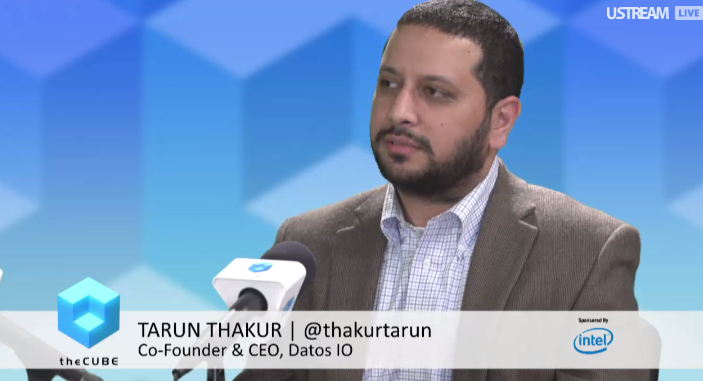
Digital transformation means many things to many people. To Tarun Thakur (pictured), co-founder and chief executive officer of Datos IO Inc., it means that the application now defines the choice of IT stack underneath. Often, he said, this means moving to the cloud, which in turn, requires a fundamental rethink of disaster recovery.
Enterprises need to be covered in the event of the “what-if” moment, such as human error, Thakur stated.
He spoke to John Furrier (@furrier), host of theCUBE, SiliconANGLE Media’s mobile live streaming studio, during an interview at SiliconANGLE’s Palo Alto, CA, studio to talk about news from the Google Cloud NEXT 2017 event. Datos IO, a provider of cloud-scale data protection software for next-generation applications, is a Google Cloud partner.
The discussion centered on Google’s attempts to penetrate the enterprise market and where its success with mainstream companies like Home Depot may lead.
Talking about Home Depot’s migration to Google Cloud, Thakur said: “The CIO down has moved their entire [eCommerce] platform — migrated from [IBM’s] DB2 to Google Cloud.” The Fortune 100 retailer chose Datos IO because of its partnership with Google Cloud.
“They understood cloud does not mean recoverability,” Thakur said.
The move by Home Depot could bode well for Google Cloud’s future with other retailers like eBay and The Gap Inc. “Those guys will hesitate to go into Amazon, because they know Amazon, at the heart, is a retail business,” he said, hinting at a conflict of interest.
The radically different infrastructure of cloud requires a different approach to recovery compared to the old database way. Because of this new requirement, Google Cloud has made a smart choice incorporating disaster resource innovators Datos IO as a partner, Thakur said.
Furrier said that in his conversation with Google Cloud Senior Vice President Diane Greene, she said that the company is actively seeking to build its portfolio of partners. Thakur agreed that Google Cloud is doing good work to beef up partner ecosystems.
On the other hand, he believes Google Cloud needs to “amp up the game around enterprise” with regards to people, processes and on-boarding.
Watch the complete video interview below, and be sure to check out more of SiliconANGLE and theCUBE’s coverage of Google Cloud NEXT 2017. (*Disclosure: Some segments on SiliconANGLE Media’s theCUBE are sponsored. Sponsors have no editorial control over content on theCUBE or SiliconANGLE.)
Support our mission to keep content open and free by engaging with theCUBE community. Join theCUBE’s Alumni Trust Network, where technology leaders connect, share intelligence and create opportunities.
Founded by tech visionaries John Furrier and Dave Vellante, SiliconANGLE Media has built a dynamic ecosystem of industry-leading digital media brands that reach 15+ million elite tech professionals. Our new proprietary theCUBE AI Video Cloud is breaking ground in audience interaction, leveraging theCUBEai.com neural network to help technology companies make data-driven decisions and stay at the forefront of industry conversations.





