



 EMERGING TECH
EMERGING TECH
EMERGING TECH
EMERGING TECH

Competition in the emerging self-driving car segment focuses in large part on the sensory equipment that allows vehicles to understand their surroundings.
One of the newest contenders is Luminar Technologies Inc., a startup led by 22-year-old physicist Austin Russell that has raised $36 million in funding. Russell and his team hit the scene today after five years in stealth development to reveal what they’ve been working on: a sensory kit for autonomous cars designed almost entirely from scratch save for a few core elements.
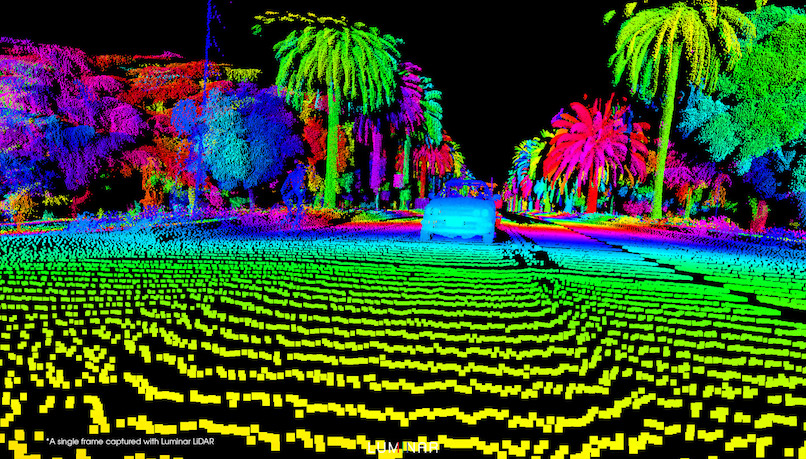
The platform is based on the Light Detection and Ranging technology that has become the de facto means of collecting environmental data in most autonomous vehicles. Generally, LiDAR systems map out their surroundings by firing off laser pulses in a circular pattern that are reflected off nearby objects into onboard cameras. What sets Luminar’s implementation apart is that it transmits light with a 1550-nanometer wavelength rather than the 905-nanometer beams normally used for the task.
It’s a seemingly small but important difference that the startups says gives it a major edge. Luminar claims that its system can spot a car 650 feet away under sub-optimal lighting conditions, four times more than the maximum range of the hardware sold by market leader Velodyne LiDAR Inc. Enabling autonomous vehicles to identify objects at longer distances could give them more time to react, which should in turn reduce the risk of accidents.
Moreover, Luminar claims that its system can accomplish this at a lower price point than the competition. A Bloomberg report published in March revealed that the startup is looking to sell the hardware for less than $1,000 per unit once it begins mass-production and move below the $100 mark within three to four years.
It’s an ambitious goal, all the more so because Luminar isn’t the only emerging player that hopes to shake up the LiDAR market. A startup called TetraVue Inc. recently raised $10 million in funding to start manufacturing a competing sensory kit that likewise has a 650-feet range. Another common point is its emphasis on affordability: TetraVue’s system can employ commodity CMOS and CCD cameras to pick up reflected laser pulses instead of requiring custom sensors as Luminar does.
Moreover, tech and auto giants such as Google Inc. parent Alphabet Inc.’s Waymo, Uber Technologies Inc. and Tesla Inc. are developing their own set of technologies, not to mention the traditional car companies.
… We’d like to tell you about our mission and how you can help us fulfill it. SiliconANGLE Media Inc.’s business model is based on the intrinsic value of the content, not advertising. Unlike many online publications, we don’t have a paywall or run banner advertising, because we want to keep our journalism open, without influence or the need to chase traffic.The journalism, reporting and commentary on SiliconANGLE — along with live, unscripted video from our Silicon Valley studio and globe-trotting video teams at theCUBE — take a lot of hard work, time and money. Keeping the quality high requires the support of sponsors who are aligned with our vision of ad-free journalism content.
If you like the reporting, video interviews and other ad-free content here, please take a moment to check out a sample of the video content supported by our sponsors, tweet your support, and keep coming back to SiliconANGLE.






