



 APPS
APPS
APPS
APPS
APPS

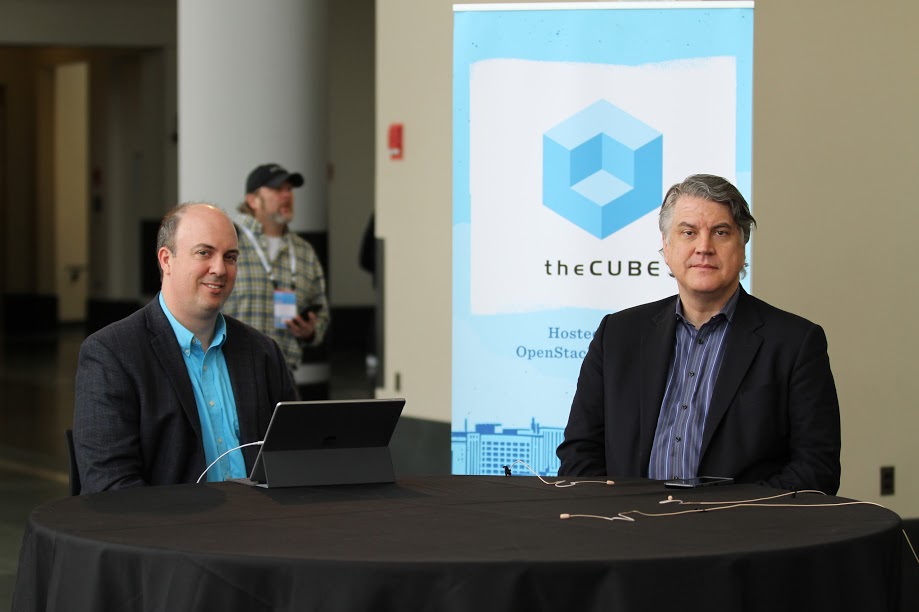
As the OpenStack Summit 2017 closed out its second day, attendees observed: “There’s an [OpenStack] ecosystem; there’s a landscape, it all has to interoperate. Usability and componentization [are] part of that,” stated John Troyer (@jtroyer) (pictured, left), guest host of theCUBE, SiliconANGLE Media’s mobile live streaming studio.
Troyer mentioned that his favorite part so far at the summit was the concept of OpenStack — an open-source software platform for cloud computing — on the edge, where you can put a full OpenStack distribution on any sort of device. Once OpenStack is on the device, it can be run as a service layer, so services can be launched from there, upgrades can be made from there, all from a central location, he said.
During the Summit, held in Boston, Massachusetts, Troyer and co-host Stu Miniman (@stu) (pictured, right) gave their observations around Day 2 of the summit. They also discussed why so many summit conversations were talking about containers and telco.
As the container space has matured, it has moved recently from virtualized to containerized environments. “Containers are just a way of packaging,” explained Troyer, going on to say that containerization can come into play in multiple points in the stack.
Miniman added that containerization is one of the devices that enable a multi-cloud world. While OpenStack sits on top, OpenShift (RedHat’s cloud development Platform as a Service) is the layer on top of OpenStack that sits at that application level layer, spanning between public or private clouds.
“We need that to enable some real multi- or hybrid clouds,” Miniman explained.
Additionally, telcom was a big discussion point at the summit. Because telcos spend a great deal of money on infrastructure, they are large-scale users, Troyer stated. Functionally speaking, networks need to have the capacity to link many different connected devices and provide streaming data services.
“If OpenStack can build a backplane for [many network functionalities], which is what they’re doing, that’s a huge proofpoint,” Troyer concluded.
Watch the complete video interview below, and be sure to check out more of SiliconANGLE’s and theCUBE’s independent editorial coverage of OpenStack Summit 2017 Boston.
… We’d like to tell you about our mission and how you can help us fulfill it. SiliconANGLE Media Inc.’s business model is based on the intrinsic value of the content, not advertising. Unlike many online publications, we don’t have a paywall or run banner advertising, because we want to keep our journalism open, without influence or the need to chase traffic.The journalism, reporting and commentary on SiliconANGLE — along with live, unscripted video from our Silicon Valley studio and globe-trotting video teams at theCUBE — take a lot of hard work, time and money. Keeping the quality high requires the support of sponsors who are aligned with our vision of ad-free journalism content.
If you like the reporting, video interviews and other ad-free content here, please take a moment to check out a sample of the video content supported by our sponsors, tweet your support, and keep coming back to SiliconANGLE.






