



 INFRA
INFRA
INFRA
INFRA
INFRA

After Nutanix Inc.’s shares tanked 14 percent March 2 when it issued a weak outlook, the maker of computer virtualization and storage appliances and software had something to prove this quarter. In short, it did.
The company reported a profit before certain costs such as stock compensation of $60.8 million, or 42 cents a share, on a 67 percent jump in revenue, to $191.8 million, in the third fiscal quarter ended April 30. Wall Street analysts had forecast $186.6 million in revenue, up 62 percent, and an adjusted loss of 45 cents per share.
Not surprisingly, investors cheered, sending shares up by almost 12 percent in after-hours trading. That’s on top of a modest 0.69 percent increase today, to $17.57. Update: In trading Friday, shares were up about 9 percent early on, then closed up 11.5 percent.
Nutanix’s shares have been volatile in recent months. On Monday, they jumped about 10 percent after Goldman Sachs raised its rating to a buy with a $31 target price, about double its price at the time. Shares are still less than half their post-IPO high last October of about $38.
Nutanix also said it expects revenues between $215 million and $220 million and an adjusted loss of 38 cents in the current quarter. DRAM memory chip costs have doubled, taking 6 percentage points off gross margins, Chief Financial Officer Duston Williams said on the call, and that impact will continue for awhile.
The company, which went public last fall, sells so-called “hyperconverged” systems that combine computing, storage and software into a single machine to provides a cloudlike setup on customers’ own premises. Hyperconverged infrastructure saves on space and power in the data center.
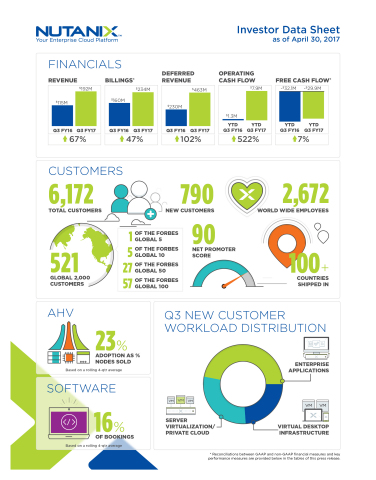 More large deals in the quarter accounted for continued growth, Chief Executive Dheeraj Pandey said in a statement before a 1:30 p.m. PDT conference call. The company said it had 34 customers spending over $1 million in the quarter. There were 13 deals over $2 million in bookings, for total of $45 million, up from only four such deals in the second quarter.
It also added 790 new customers, including Caterpillar Inc., SAIC Volkswagen and Sprint Corp., bringing the total customer count to 6,172.
Pandey has big ambitions for his company to become something like the Microsoft Windows of the cloud era. “Building an operating system is a journey, and no more than one or two are successful in a decade,” Pandey said on the conference call.
Among others, Nutanix competes against Hewlett Packard Enterprise Co., Dell EMC, NetApp Inc. and Pure Storage Inc. The latter two reported earnings Wednesday, with both outperforming expectations but Pure seeing the biggest stock surge thanks to a better-than-expected outlook.
Analysts expect software revenues to grow quickly, from 6.5 percent a year ago to about 11 percent in the third quarter. Last week, Nutanix said it’s joining with IBM Corp. to sell appliances running its software on servers using IBM’s Power Systems chips.
In an interview today with SiliconANGLE, Pandey compared what Nutanix is trying to do with its cloud operating system to what happened when Blackberry got disrupted by Apple Inc.’s iPhone and Android phones. The latter pair realized “phones” were becoming something more than just voice and email, and created new platforms for thousands of applications.
Pandey said legacy hardware providers are thinking of “hyperconverged” systems in the same limited way as Blackberry did. “The power is now going to the application layer and the application developers,” he said, and Nutanix aims to be the platform for cloud enterprise applications.
“They’re trying to message that they’re moving beyond hyperconverged infrastructure–moving faster than the competition and focusing on cloud as the next wave,” said David Vellante, chief analyst with the analyst group Wikibon, owned by the same company as SiliconANGLE. But he said it remains to be seen how many companies will see Nutanix’s solution as enough better than, say, VMware Inc.’s, especially under the Dell EMC umbrella. And public cloud providers such as Amazon Web Services Inc. are rapidly persuading companies to put more of their computing workloads in the cloud rather than on-premises.
Pandey also spoke at Dell EMC World in March with theCUBE, SiliconANGLE’s mobile video studio:
… We’d like to tell you about our mission and how you can help us fulfill it. SiliconANGLE Media Inc.’s business model is based on the intrinsic value of the content, not advertising. Unlike many online publications, we don’t have a paywall or run banner advertising, because we want to keep our journalism open, without influence or the need to chase traffic.The journalism, reporting and commentary on SiliconANGLE — along with live, unscripted video from our Silicon Valley studio and globe-trotting video teams at theCUBE — take a lot of hard work, time and money. Keeping the quality high requires the support of sponsors who are aligned with our vision of ad-free journalism content.
If you like the reporting, video interviews and other ad-free content here, please take a moment to check out a sample of the video content supported by our sponsors, tweet your support, and keep coming back to SiliconANGLE.






