



 APPS
APPS
APPS
APPS
APPS

CoreOS Inc. is adding features to its Tectonic container management platform as it welcomes 800 open source and container fans to its CoreOS Fest conference this week in San Francisco.
The enhancements enable greater portability of applications across hybrid clouds while giving customers freedom to switch vendors and platforms, the company said. CoreOS sells a Kubernetes-based software suite for automated operations that enables organizations to deliver their own clouds regardless of underlying infrastructure.
The company, which started out as a builder of an alternative to the popular Docker container, has been pivoting to focus on management tools and platforms to manage large containerized environments, with a particular focus on Kubernetes. “The challenge is that there are dozens of companies trying to be ‘the Kubernetes answer'” said Stu Miniman, Senior analyst at research firm Wikibon, a sister company to SiliconANGLE. That list includes potent competitors like Mirantis Inc., Red Hat Inc., Google and Heptio Inc., which was started by Kubernetes’ creators.
Miniman said CoreOS can thrive if it sticks to its strengths and focuses on delivering value in open source. “They still have a relatively small team and aren’t overextending themselves or making claims that are too bold,” he said.
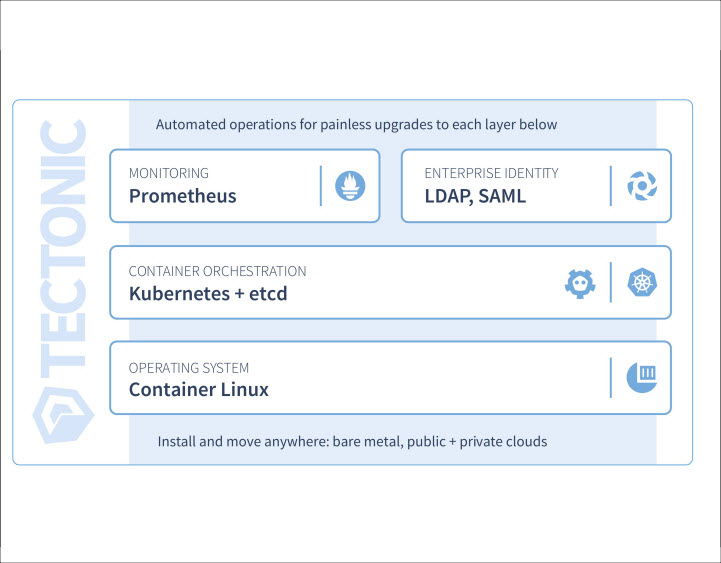
Tectonic 1.6.4 features what the company calls “etcd as a service,” referring to the open-source distributed key-value store that provides a canonical hub for cluster coordination and state management across clusters of machines. The company’s etcd Operator can provision etcd for use by applications deployed on Tectonic. This simplifies scaling, failure-handling and version updates to maintain a continuous desired state. An Operator is an application-specific controller that extends the Kubernetes API to create, configure and manage instances of complex stateful applications on behalf of a Kubernetes user.
CoreOS is also announcing the Container Linux Operator as the default Linux controller in Tectonic. The Kubernetes-native Operator automates operating system updates. When combined, the Container Linux and etcd Operators enable administrators to increase the effectiveness and security of their operations through automated updates to the Kubernetes cluster control plane, worker node operating systems, and etcd service instances.
CoreOS Tectonic is priced per node and is free to use for up to 10 nodes. Pricing information was not made available.
The company also released the results of a survey of more than 200 enterprise information technology managers conducted by 451 Research Inc. that reveals that 57 percent prefer a combination of both hosted and on-premise containers-as-a-service.
Nearly three-quarters of the managers who were surveyed are using Kubernetes, the top benefits of which they identify as freeing up resources to better focus priorities, enabling hybrid-cloud/cross-cloud support, self-service automation and freedom from vendor lock-in. More than half say they are running container management and orchestration software in production today. That’s up from just 10 percent in 451 Research’s 2015 study.
DevOps teams are most concerned about developer productivity, while infrastructure teams cite efficiency as the primary reason to embrace containers. The survey also found that despite the frequent association of containers with developers, IT operations people are the primary user of containers in most organizations. Training internal teams on container technology is the top organizational challenge, with internal culture, fear of redundancy and the immaturity of containers identified as other significant hurdles.
… We’d like to tell you about our mission and how you can help us fulfill it. SiliconANGLE Media Inc.’s business model is based on the intrinsic value of the content, not advertising. Unlike many online publications, we don’t have a paywall or run banner advertising, because we want to keep our journalism open, without influence or the need to chase traffic.The journalism, reporting and commentary on SiliconANGLE — along with live, unscripted video from our Silicon Valley studio and globe-trotting video teams at theCUBE — take a lot of hard work, time and money. Keeping the quality high requires the support of sponsors who are aligned with our vision of ad-free journalism content.
If you like the reporting, video interviews and other ad-free content here, please take a moment to check out a sample of the video content supported by our sponsors, tweet your support, and keep coming back to SiliconANGLE.






