



 CLOUD
CLOUD
CLOUD
CLOUD
CLOUD

As of this week, companies that rely on Google Inc.’s cloud platform to process their media assets should see a noticeable improvement in results.
The search giant on Thursday announced several enhancements to its object recognition services aimed at increasing the accuracy with which they can identify and categorize items. Most of the changes affect Google’s Cloud Vision application programming interface for tapping into the service, which was first introduced two years ago when the notion of incorporating artificial intelligence into applications was only starting to go mainstream. The company now hopes to up the ante against the numerous rivals that have joined the fray since.
To that end, Google is taking advantage of its leadership position in the search market. New integration with the company’s image search tool enables Cloud Vision API to identify the key elements of a picture and fetch similar photos from around the web. Customers apparently see quite a few applications for the feature, with Google claiming that developers used it to process more than 10 million images during beta testing.
The capability is joined by several improvements to Cloud Vision API’s core object recognition mechanism. Google has increased the number of item categories that the service can identify to more than 10,000, doubled the accuracy with which its algorithms distinguish facial expressions such as surprise and sped up the text recognition feature.
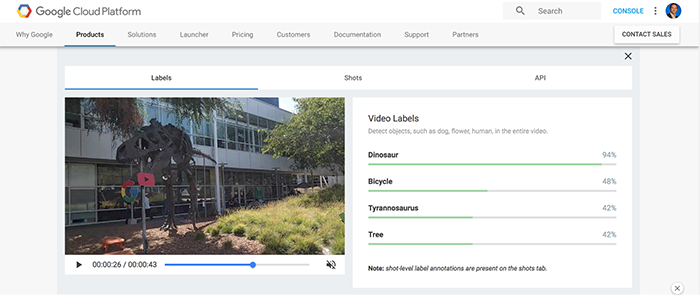
Topping it off is a 30 percent reduction in the error rate of the service’s Safe Search mode for detecting inappropriate content. Google has also added a similar filter to Cloud Video Intelligence, a complementary service that can automatically categorize a clip based on its contents. A media company, for example, could use the tool to make archived broadcasts more easily searchable.
The enhancements are the latest in a series of computer vision updates that Google has made over recent weeks. Previously, the search giant added an object recognition feature to its popular TensorFlow AI engine that aims to ease the creation of image processing applications. The framework includes more than a half-dozen readymade models, including the MobileNets family that Google introduced earlier this month.
… We’d like to tell you about our mission and how you can help us fulfill it. SiliconANGLE Media Inc.’s business model is based on the intrinsic value of the content, not advertising. Unlike many online publications, we don’t have a paywall or run banner advertising, because we want to keep our journalism open, without influence or the need to chase traffic.The journalism, reporting and commentary on SiliconANGLE — along with live, unscripted video from our Silicon Valley studio and globe-trotting video teams at theCUBE — take a lot of hard work, time and money. Keeping the quality high requires the support of sponsors who are aligned with our vision of ad-free journalism content.
If you like the reporting, video interviews and other ad-free content here, please take a moment to check out a sample of the video content supported by our sponsors, tweet your support, and keep coming back to SiliconANGLE.






