



 EMERGING TECH
EMERGING TECH
EMERGING TECH
EMERGING TECH

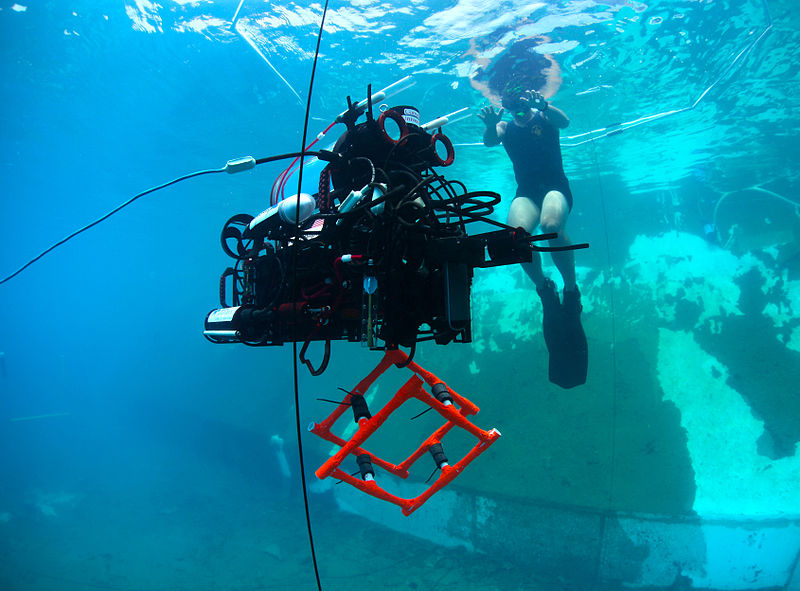
When most people think of drones, they think of devices that fly through the sky, taking pictures or blowing up terrorists. But the next wave of drones will operate under the sea, where signals from a global positioning satellite do not penetrate.
That problem is something for which the same U.S. government department that gave us the Internet says it has a solution. DARPA, the U.S. government Defense Advanced Research Projects Agency, in conjunction with BAE Systems plc, is proposing a system of undersea buoys that would operate in a similar fashion the GPS satellite system but for underwater drones. Dubbed POSYDON, short for Positioning System for Deep Ocean Navigation, the proposed system would provide “an undersea system that provides omnipresent, robust positioning across ocean basins” to allow autonomous drones to navigate for potential tasks such as identifying mines, finding enemy submarines or to identify any items relevant to combat missions.
“By ranging to a small number of long-range acoustic sources, an undersea platform would be able to obtain continuous, accurate positioning without surfacing for a GPS fix,” DARPA said on the website for the project.
While currently only at a proposal stage, the first stage of the program is focusing on accurately modeling the signal propagation channel — or to put it more simply, how a drone would communicate with the system. The second stage is focused on developing the signal waveform, and the third stage of the project being a demonstration deployment of the system to prove that it works.
“GPS signals bounce off ocean surfaces and cannot penetrate seawater,” Geoff Edelson, director of Maritime Systems and Technology at BAE Systems told Scout.com. “The importance of POSYDON is to make sure that these UUVs [unmanned underwater vehicles] can really focus on their missions without having to periodically come to the surface for GPS to figure out exactly where they are.”
It may take a futurist or an author of science fiction to predict a future where submarines may become redundant and are replaced instead by autonomous underwater drones. But that’s exactly what DARPA is aiming to create in the not-so-distant future.
… We’d like to tell you about our mission and how you can help us fulfill it. SiliconANGLE Media Inc.’s business model is based on the intrinsic value of the content, not advertising. Unlike many online publications, we don’t have a paywall or run banner advertising, because we want to keep our journalism open, without influence or the need to chase traffic.The journalism, reporting and commentary on SiliconANGLE — along with live, unscripted video from our Silicon Valley studio and globe-trotting video teams at theCUBE — take a lot of hard work, time and money. Keeping the quality high requires the support of sponsors who are aligned with our vision of ad-free journalism content.
If you like the reporting, video interviews and other ad-free content here, please take a moment to check out a sample of the video content supported by our sponsors, tweet your support, and keep coming back to SiliconANGLE.







_built_by_students_from_Cornell_University_after_navigating_through_an_130724-N-TM257-006.jpg)