



 APPS
APPS
APPS
APPS
APPS

The technology wave sweeping agriculture is impacting the entire range of organizations supporting the industry. In order to serve the needs of a massively growing population, all segments of industry must come together in order to produce a systematic solution, including academic institutions.
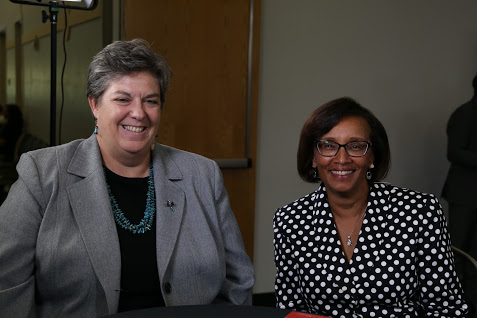
“It’s going to be a balance trying to figure out how to provide the needs of all of these different audiences. I don’t think one farmer can do it for all of these different groups that have different demands on what they’re looking for,” said Dr. Helene Dillard (pictured, right), dean of the College of Agricultural and Environmental Sciences at UC Davis.
Dillard and Dr. Glenda Humiston (pictured, left), vice president of agriculture and natural resources at the University of California, Berkeley, spoke with Jeff Frick (@JeffFrick), host of theCUBE, SiliconANGLE Media’s mobile livestreaming studio, during this year’s Food IT: Fork to Farm event in Mountain View, California. They discussed their academic perspectives on the agriculture tech revolution. (* Disclosure below.)
The food supply chain is so intertwined and complex that making a meaningful change to it requires coordination between each individual contributor to improve it’s performance, according to Humiston and Dillard.
“It really does take a systems approach. A great example is that UC Davis, my division and other parts of the UC system are working on a central valley agriculture plus food and beverage consortium,” Humiston said. “It’s looking at bringing around the table folks from R&D, trained workforce, adequate infrastructure, finance, supply chain and having them actually work together to design what’s needed.”
The recently launched Verde Innovation Network for Entrepreneurship, known as The VINE, is one example of this type of coordinated approach, according to Dillard. The VINE aims at bringing together scattered resources around California and facilitating access to them in a unified network.
“It’s our attempt from University of California to catalyze regional innovation and entrepreneurship ecosystems. … We’ve got a fairly good amount of resources scattered around the state … small business development centers, our community colleges, our county cooperative extension offices … incubator, accelerators. But they don’t talk to each other. So we’re trying to go in region by region and catalyze a coalition,” Humiston explained.
Watch the complete video interview below, and be sure to check out more of SiliconANGLE’s and theCUBE’s coverage of the FOOD IT: Fork to Farm event. (* Disclosure: TheCUBE is a paid media partner for FOOD IT: Fork to Farm. Neither Western Digital Corp., the event sponsor, nor other sponsors have editorial influence on theCUBE or SiliconANGLE.)
… We’d like to tell you about our mission and how you can help us fulfill it. SiliconANGLE Media Inc.’s business model is based on the intrinsic value of the content, not advertising. Unlike many online publications, we don’t have a paywall or run banner advertising, because we want to keep our journalism open, without influence or the need to chase traffic.The journalism, reporting and commentary on SiliconANGLE — along with live, unscripted video from our Silicon Valley studio and globe-trotting video teams at theCUBE — take a lot of hard work, time and money. Keeping the quality high requires the support of sponsors who are aligned with our vision of ad-free journalism content.
If you like the reporting, video interviews and other ad-free content here, please take a moment to check out a sample of the video content supported by our sponsors, tweet your support, and keep coming back to SiliconANGLE.






