



 BIG DATA
BIG DATA
BIG DATA
BIG DATA

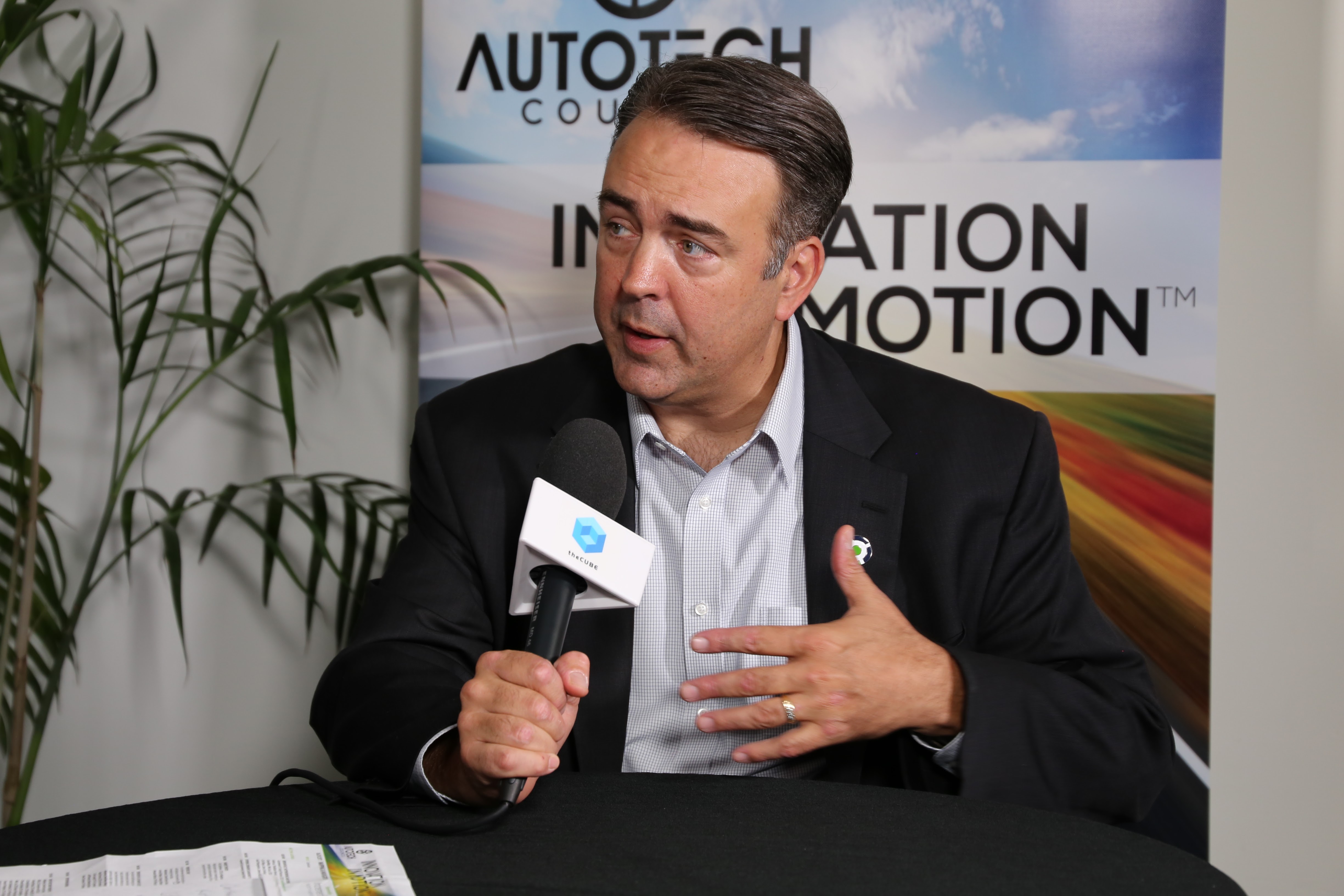
Smart cities are playing a big part in aiding the growth of self-driving cars by providing additional sensor data to enhance vehicle safety and navigation. In order to facilitate the transfer of information from the smart cities to data consumers, Christian Kotscher (pictured), founder and chief executive officer of MetroTech Net Inc., started a company that is building a real-time traffic data exchange.
“We go to existing cities and counties and take their existing sensors to bring them into our cloud-based system, where we convert them into real-time traffic data. … What we do on the exchange is we publish it out to not just the cities, but also the people driving on their streets. We’re basically setting up the necessary data exchange that allows smarter cities to speak with autonomous vehicles and connected cars,” Kotscher said.
Kotscher spoke with Jeff Frick (@JeffFrick), host of theCUBE, SiliconANGLE Media’s mobile livestreaming studio, during this year’s Auto Tech Council – Innovation in Motion event in Milpitas, California. They discussed the data exchange Metrotech is building. (* Disclosure below.)
A large component of the data coming onto MetroTech’s exchange comes from existing sensor deployments stemming from smart city initiatives. This data, however, is often not ready to be consumed by modern applications in connected vehicles.
“If you look at open data initiatives in San Francisco or New York, what they were doing was just putting a bunch of spreadsheets online. That’s open but not useful,” Kotscher said. “There’s data we’ve got to get out of the cabinets back at the city hall, back into the traffic management centers, but then we’ve got to publish it out, and those standards have not been written.”
As more of the data already being generated is pulled onto the exchange, consumers can apply modern techniques, such as machine learning, to extract more value from the original data set, Kotscher explained.
“Every city has a significant amount of infrastructure already out there, especially in the way of cameras. … Right now the police will use them for stakeouts and traffic … will use them to respond to accidents. … We take that video analytics into our engine … and we’ve got examples of that in some of the smarter cities,” Kotscher stated.
Watch the complete video interview below, and be sure to check out more of SiliconANGLE’s and theCUBE’s coverage of Auto Tech Council – Innovation in Motion. (* Disclosure: TheCUBE is a paid media partner for Auto Tech Council – Innovation in Motion. Neither Western Digital Corp., the event sponsor, nor other sponsors have editorial influence on theCUBE or SiliconANGLE.)
… We’d like to tell you about our mission and how you can help us fulfill it. SiliconANGLE Media Inc.’s business model is based on the intrinsic value of the content, not advertising. Unlike many online publications, we don’t have a paywall or run banner advertising, because we want to keep our journalism open, without influence or the need to chase traffic.The journalism, reporting and commentary on SiliconANGLE — along with live, unscripted video from our Silicon Valley studio and globe-trotting video teams at theCUBE — take a lot of hard work, time and money. Keeping the quality high requires the support of sponsors who are aligned with our vision of ad-free journalism content.
If you like the reporting, video interviews and other ad-free content here, please take a moment to check out a sample of the video content supported by our sponsors, tweet your support, and keep coming back to SiliconANGLE.






