



 CLOUD
CLOUD
CLOUD
CLOUD
CLOUD

In the virtualized data center environment, there is seemingly no place for tape storage. But following Veeam Software Inc.’s “3-2-1 rule,” with three copies of data on two different kinds of media plus one stored offsite, Quantum has resurrected tape storage as a viable option for backup and recovery in the enterprise.
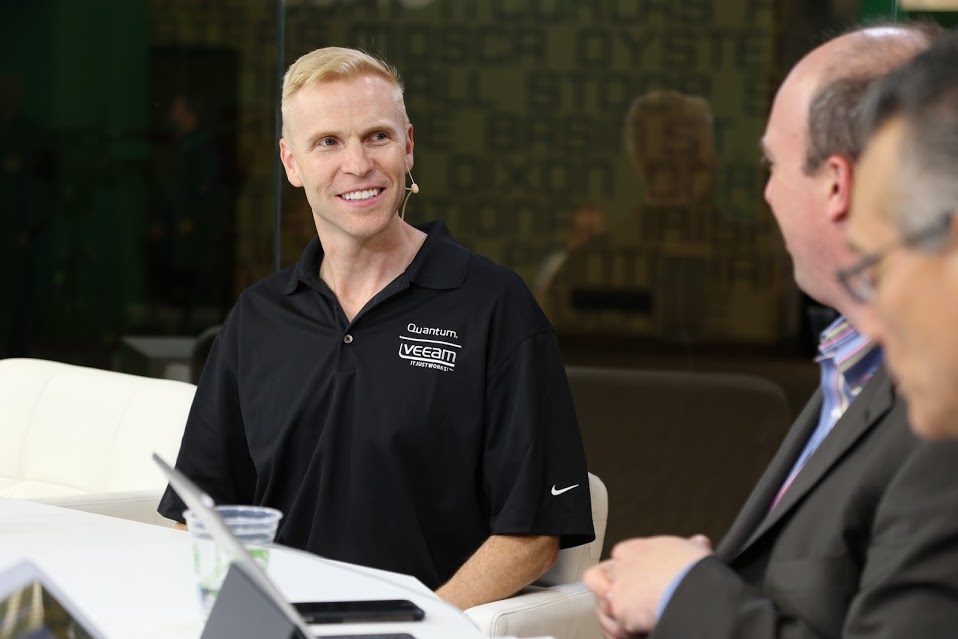
“I think there’s a really good place for tape as long term storage for massive scale unstructured data. We‘re seeing almost a resurgence in relevance just from that perspective,” said Eric Bassier (pictured), senior director of datacenter products at Quantum Corp.
Bassier stopped by theCUBE, SiliconANGLE Media’s mobile livestreaming studio, and answered questions from co-hosts Dave Vellante, (@dvellante) and Stu Miniman, (@stu), during this year’s VeeamOn event in New Orleans, Louisiana. They discussed the reasons behind using tape storage and Quantum’s recent integration announcements with Veeam. (* Disclosure below.)
Bassier acknowledged that one of the key factors driving tape usage is the rise of ransomware. By creating tape backups at least once a day, if the enterprise is hit with an attack, the data will still be protected with an offline copy.
Quantum recently announced the Scalar iBlade, a tape storage solution in the Veeam environment that eliminates the need for an external tape server. “Our focus is about secondary storage,” Bassier said. “There’s nobody else in the market that has anything like this for tape.”
Quantum also announced that DXi deduplication appliances will now support Veeam’s VM recovery and synthetic full backup offerings. The integration with Veeam’s data mover service will result in faster speeds, according to Bassier.
“Net for a customer, it just makes operations like instant VM recovery or creating a synthetic full backup 10 times faster or 20 times faster than where we were previously,” he added.
Veeam’s progression from backup availability to data management and enhancing secondary storage is a positive step for the industry, Bassier stated. “I’m excited about the direction Veeam is taking. I think we can have a hardware or storage portfolio that complements Veeam really well, and it will bring that much more to the table for their customers,” he concluded.
Watch the complete video interview below, and be sure to check out more of SiliconANGLE’s and theCUBE’s coverage of VeeamOn 2017. (* Disclosure: TheCUBE is a paid media partner for VeeamOn 2017. Neither Veeam Software Inc. nor other sponsors have editorial influence on theCUBE or SiliconANGLE.)
… We’d like to tell you about our mission and how you can help us fulfill it. SiliconANGLE Media Inc.’s business model is based on the intrinsic value of the content, not advertising. Unlike many online publications, we don’t have a paywall or run banner advertising, because we want to keep our journalism open, without influence or the need to chase traffic.The journalism, reporting and commentary on SiliconANGLE — along with live, unscripted video from our Silicon Valley studio and globe-trotting video teams at theCUBE — take a lot of hard work, time and money. Keeping the quality high requires the support of sponsors who are aligned with our vision of ad-free journalism content.
If you like the reporting, video interviews and other ad-free content here, please take a moment to check out a sample of the video content supported by our sponsors, tweet your support, and keep coming back to SiliconANGLE.






