



 EMERGING TECH
EMERGING TECH
EMERGING TECH
EMERGING TECH

Animals are lesser beings than humans. That’s the biggest takeaway from a newly proposed law in Germany that defines ethical standards with self-driving cars.
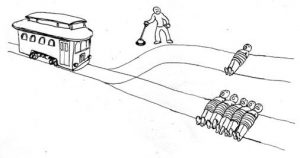
The new law, proposed by the German Federal Ministry of Transport and Digital Infrastructure, attempts to define how artificial intelligence technology behind a self-driving vehicle should prioritize damage control, which is a nice way of saying whom it should kill first in a crash.
The proposed law states that humans should be protected if possible ahead of animals and inanimate objects in all instances. Although it’s easy to think of Orwell’s “Animal Farm,” where some animals are “more equal than others,” the ethical question of harm management in the event of an accident is a serious issue when it comes to self-driving cars and artificial intelligence in general.
“The interaction between man and machine raises new ethical questions during the time of digitization and self-learning systems,” German Minister Alexander Dobrindt said. “Automated and networked driving is the latest innovation in which this interaction is applied in full. The Ethics Commission at the [Department] has done…. pioneering work and has developed the world’s first guidelines for automated driving. We are now implementing these guidelines.”
Along with prioritizing human lives, the proposed law also goes further. It says self-driving cars shouldn’t discriminate against killing one human over another, stating that “no decisions should be made on age, sex, physical or mental constitution.” Self-driving cars will also be required to have a surveillance system in place – such as a black box – that records the steps leading to an accident so that it can be determined what caused the accident and whether the right decision by the self-driving car was made.
 Because this is Europe, the proposed law also has privacy protections included, specifically that a “driver” should have full control over personal information collected from the vehicle.
Ethical considerations of how artificial intelligence makes decisions is not restricted to self-driving cars. While Elon Musk may be the biggest scaremonger, in the United States it has already been asked whether it’s acceptable for AI to make serious decisions. For example, is it acceptable for a computer to determine the validity of online content?
So far, no U.S. state has yet taken on the ethical considerations of self-driving cars and whom they should kill first in an accident, and a federal panel on self-driving cars has stalled. But if the German law is passed, that could change.
… We’d like to tell you about our mission and how you can help us fulfill it. SiliconANGLE Media Inc.’s business model is based on the intrinsic value of the content, not advertising. Unlike many online publications, we don’t have a paywall or run banner advertising, because we want to keep our journalism open, without influence or the need to chase traffic.The journalism, reporting and commentary on SiliconANGLE — along with live, unscripted video from our Silicon Valley studio and globe-trotting video teams at theCUBE — take a lot of hard work, time and money. Keeping the quality high requires the support of sponsors who are aligned with our vision of ad-free journalism content.
If you like the reporting, video interviews and other ad-free content here, please take a moment to check out a sample of the video content supported by our sponsors, tweet your support, and keep coming back to SiliconANGLE.







