 INFRA
INFRA
INFRA
INFRA







INFRA

First hyperconverged infrastructure combined software-defined storage with commodity hardware for an on-premises “private cloud.” Now converged infrastructure startup Datrium Inc. wants to go further by mimicking public cloud in on-prem or hybrid environments.
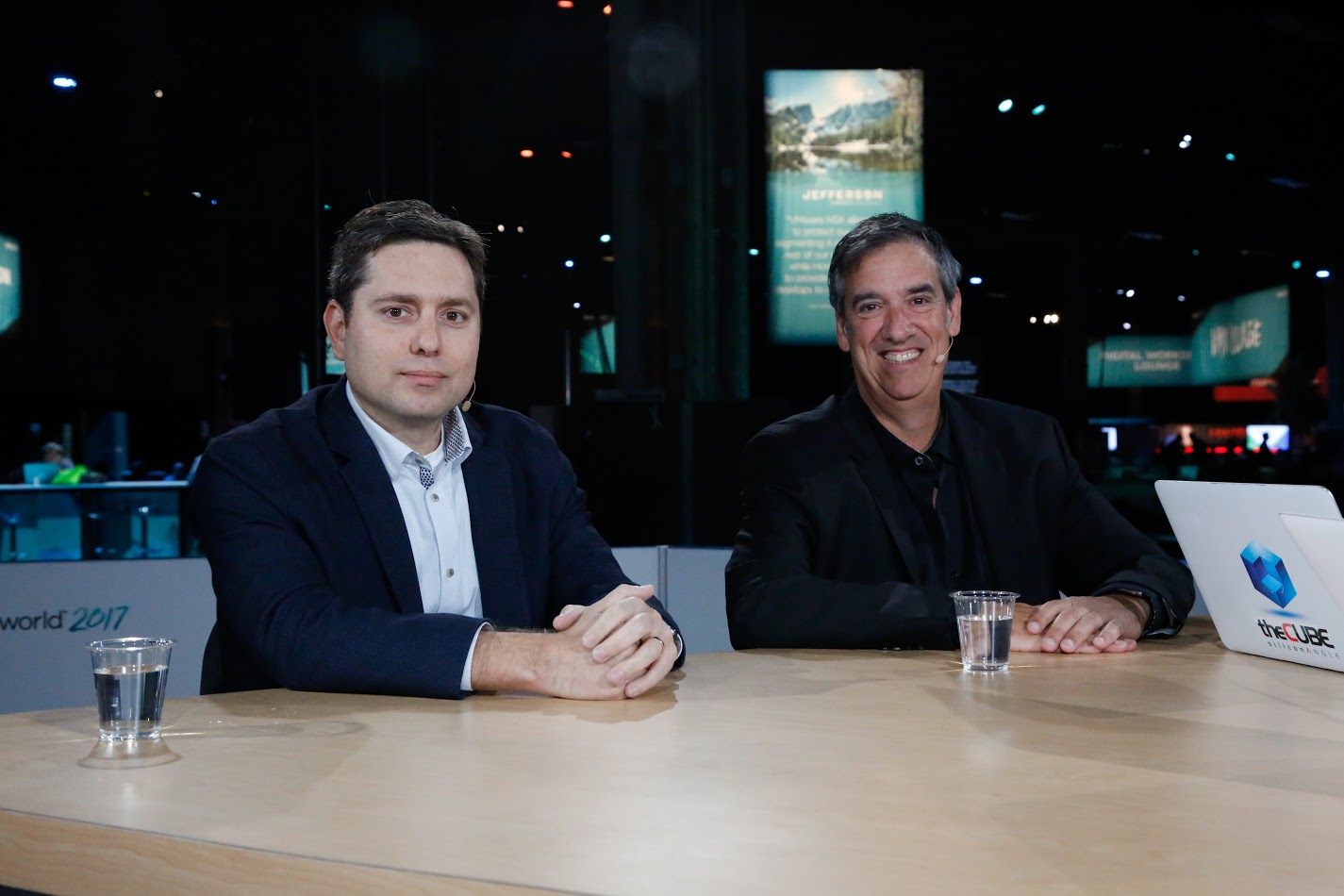
Datrium’s mission is “to give customers in this hybrid world a way to bring that kind of infrastructure with the simplicity, scale, performance you need kind of on-prem,” said Craig Nunes (pictured, right), vice president of marketing at Datrium.
Nunes joined Andre Leibovici (pictured, left), vice president of solutions & alliances, in a live interview at VMworld 2017 in Las Vegas, Nevada.
Public clouds separate persistent storage capacity from what happens on compute nodes to scale low latency workloads as needed, Nunes explained. And so does Datrium, he told John Furrier (@furrier) and Dave Vellante (@dvellante), co-hosts of theCUBE, SiliconANGLE Media’s mobile livestreaming studio. It differs from HCI in its innovative decoupling of the persistent storage layer from Input/Output processing on the server. (* Disclosure below.)
This kinship of processes means Datrium workloads fit more easily in public cloud and vice versa, according to Nunes. “You can very easily map that capacity layer to capacity layer, compute to compute instead of this kind of crazy dance,” he said.
Datrium users can implement certain cloud technologies on-prem without the typical strains of doing so, Nunes explained. Datrium was founded by VMware Inc. engineers, and lots of enterprise customers remain VM-centric. However, “a lot of people we talk to, they have nascent container development work going on,” Nunes said. Containers are a virtualized method for running distributed apps.
“Those kinds of customers wind up having to silo out the infrastructure that supports those because they just don’t have the bridge,” Nunes said. With Datrium, they can run virtual machines; they can run containers in VMs; or they run containers on bare metal. “It’s all one shared pool of resources like it ought to be,” he added.
Many customers ultimately opt not to run containers in the cloud, according to Leibovici.
“As soon as they figure out the framework, the management, the orchestration, they want to move to bare metal, because they want to harvest that additional 10- to 15-percent performance that they get,” Leibovici said. “Talking to Docker and a few other companies out there, that’s what they see in their customer base as well.”
Watch the complete video interview below, and be sure to check out more of SiliconANGLE’s and theCUBE’s coverage of VMworld 2017. (* Disclosure: TheCUBE is a paid media partner for VMworld 2017. Neither VMware Inc. nor Datrium Inc. have editorial control over content on theCUBE or SiliconANGLE.)
Support our mission to keep content open and free by engaging with theCUBE community. Join theCUBE’s Alumni Trust Network, where technology leaders connect, share intelligence and create opportunities.
Founded by tech visionaries John Furrier and Dave Vellante, SiliconANGLE Media has built a dynamic ecosystem of industry-leading digital media brands that reach 15+ million elite tech professionals. Our new proprietary theCUBE AI Video Cloud is breaking ground in audience interaction, leveraging theCUBEai.com neural network to help technology companies make data-driven decisions and stay at the forefront of industry conversations.





