



 CLOUD
CLOUD
CLOUD
CLOUD
CLOUD

Being able to mix and match software components in container configuration has become an important part of virtualizing the distribution of applications in the enterprise stack. So when Docker Inc. announced the Moby Project at DockerCon earlier this year, it was both an opportunity to capitalize on innovations in the open-source community to further the container cause, as well as a way to counter growing third-party orchestration adoption outside the company’s commercial offerings.
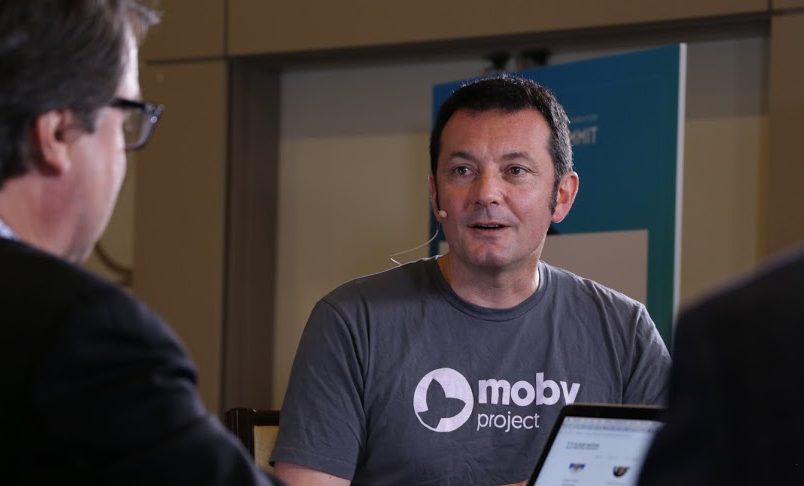
“It’s the end of a two-year refactoring of the Docker code base into different components. We’re seeing more developers joining the bandwagon,” said Patrick Chanezon (pictured), member of the technical staff at Docker.
Chanezon paid a visit to theCUBE, SiliconANGLE’s mobile livestreaming studio, and spoke with co-hosts John Furrier (@furrier) and Stu Miniman (@stu) during Open Source Summit in Los Angeles, California. They discussed Moby’s objectives, other Docker projects and new tools that could soon be released from the open-source community. (* Disclosure below.)
The Moby Project was set up by Docker to provide support in the container community. It’s an open-source project where developers can collaborate and build container-based systems. It’s also a tool that can be used to assemble a variety of components such as LinuxKit and Notary.
“Moby has seen a lot of traction for its different projects,” Chanezon said.
Notary, which offers a layer of security by allowing developers to trust container images as they are built, could become part of a stream of components that are donated to the influential Cloud Native Computing Foundation.
“We started proposing to donate some of these component projects to CNCF,” Chanezon said. “We think this could be used in lots of cloud-native systems.”
There has been speculation around which of the projects currently underway in CNCF may soon “graduate” or reach enough maturity for full release. It appears that containerd (a container runtime daemon) may soon emerge, according to Chanezon. It’s not clear, however, which projects may graduate beyond that.
“CNCF is working on lots of different areas where there needs to be more definition around what cloud native means for storage and container networking interface” Chanezon concluded.
Watch the complete video interview below, and be sure to check out more of SiliconANGLE’s and theCUBE’s coverage of Open Source Summit 2017. (* Disclosure: TheCUBE is a paid media partner for Open Source Summit 2017. Neither The Linux Foundation nor Red Hat Inc. have editorial control over content on theCUBE or SiliconANGLE.)
… We’d like to tell you about our mission and how you can help us fulfill it. SiliconANGLE Media Inc.’s business model is based on the intrinsic value of the content, not advertising. Unlike many online publications, we don’t have a paywall or run banner advertising, because we want to keep our journalism open, without influence or the need to chase traffic.The journalism, reporting and commentary on SiliconANGLE — along with live, unscripted video from our Silicon Valley studio and globe-trotting video teams at theCUBE — take a lot of hard work, time and money. Keeping the quality high requires the support of sponsors who are aligned with our vision of ad-free journalism content.
If you like the reporting, video interviews and other ad-free content here, please take a moment to check out a sample of the video content supported by our sponsors, tweet your support, and keep coming back to SiliconANGLE.






