



 APPS
APPS
APPS
APPS
APPS

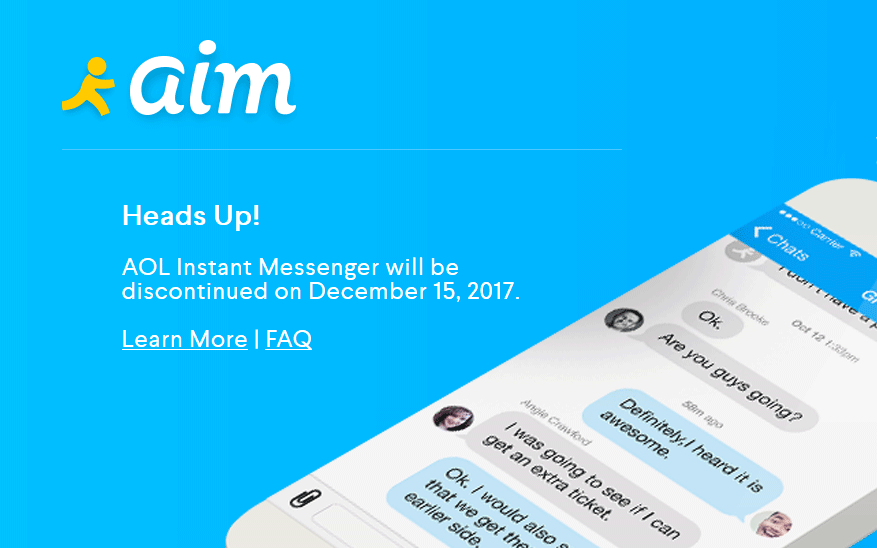
One of the internet’s first instant messaging services will go dark in two months when AOL Instant Messenger goes offline.
Oath Inc., a subsidiary of Verizon Communications that now owns the AOL brand, officially announced this morning that AIM will shut down Dec. 15.
America Online Inc. is best known as one of the very first mass-market internet access via dial-up modems in the early 1990s. For people who grew up in that era, AOL is best known for its mass marketing campaign that included millions of compact discs sent through mail and offers of free service for a month or two.
With the rise of AOL’s internet hegemony, AOL Instant Messenger or AIM took off like wildfire. At the time it represented a new way to communicate online, faster than e-mail and more direct than a chat room. AIM’s launch gave popularity to the communication platform, which led to the rise of competition such as ICQ and it’s shrill “Uh oh!,” Yahoo Instant Messenger, MSN Messenger and eventually Google Talk.
“AIM tapped into new digital technologies and ignited a cultural shift, but the way in which we communicate with each other has profoundly changed,” Michael Albers, vice president of communications product at Oath, said about the shutdown decision. “As a result, we’ve made the decision that we will be discontinuing AIM effective December 15, 2017.”
AIM launched in 1997 and rose to popularity rapidly in the late 1990s in large part because of the novelty of the experience: Get on a computer, open up a chat window and instantly have access to any one of your friends who were online. It was a model that predated Short Message Service on smartphones (or even the wide use of smartphones) that quickly became the consumer-side practice for message sending.
Instant messaging as popularized by AIM could also be said to have brought on greater popularization primitive forms of “text speech” and began to spread the popularity of early emoticons and emojis. North Americans, in particular, found appeal in the sideways smile or “:) ,” which had already been in use on internet forums since the advent of Usenet and in chat rooms.
It is thought that AIM at one time held the largest share of the instant messaging market in North America during 2006, measuring in at approximately 53 million users. This market dominance would quickly decline by 2011 with the advent of Google Chat and widespread use of SMS text messaging and social media platforms. In 2012, AOL disbanded its team of developers for AIM and effectively discontinued all development of the platform after 15 years.

The end of AIM is truly the end of an internet epoch.
Current users of AIM can read this Frequently Asked Questions from Oath about the discontinuation of the instant messenger app to see how it affects them. The company has not released any details about any replacement or intent to build a replacement for AIM.
… We’d like to tell you about our mission and how you can help us fulfill it. SiliconANGLE Media Inc.’s business model is based on the intrinsic value of the content, not advertising. Unlike many online publications, we don’t have a paywall or run banner advertising, because we want to keep our journalism open, without influence or the need to chase traffic.The journalism, reporting and commentary on SiliconANGLE — along with live, unscripted video from our Silicon Valley studio and globe-trotting video teams at theCUBE — take a lot of hard work, time and money. Keeping the quality high requires the support of sponsors who are aligned with our vision of ad-free journalism content.
If you like the reporting, video interviews and other ad-free content here, please take a moment to check out a sample of the video content supported by our sponsors, tweet your support, and keep coming back to SiliconANGLE.






