



 CLOUD
CLOUD
CLOUD
CLOUD
CLOUD

Starting today, managing schedules in Google Calendar will become a much smoother experience.
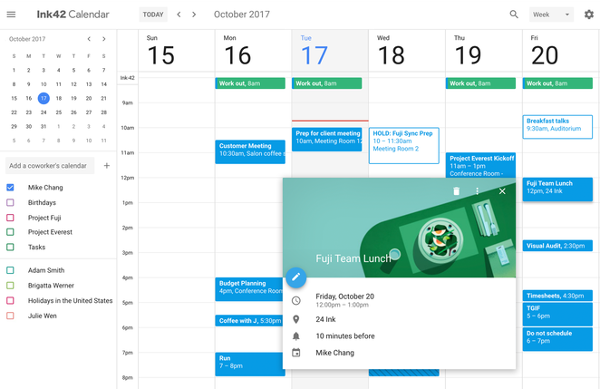
Google LLC has released a new iteration of the service with a fresh design that borrows the color scheme and spacious layout of the mobile version. The view is automatically adjusted to fill the screen of the user’s device, while important elements such as the date icons are now larger. These visual enhancements are rolling out alongside new features aimed at easing scheduling for business users.
Arguably the biggest change has to do with how calendar information is presented. When inputting details about their company’s meeting rooms, a G Suite administrator can now specify the location of each space, its size, any communications equipment that may be available inside and whether or not there’s wheelchair access.
Over on the front end, workers can view available conference rooms alongside the contact information of the people invited to a meeting. They also have access to a revamped meeting invite creator. The new Google Calendar interface introduces the ability to provide links to relevant files, such as a spreadsheet with key talking points or business documents needed for a brainstorming session.
If the need arises, users can split up the interface to manage multiple calendars side-by-side. Google sees this feature coming particularly handy for administrative assistants who handle the schedules of multiple people within a company.
The new interface went live this morning. However, Google is also accommodating organizations that require time to make the switch with two gradual rollout options.
The first is the so-called Automatic mode, which will incrementally move users to the new version over a period of about eight weeks. The process is set to commerce on Nov. 14 at companies that participate in Google’s Rapid Release program and on Nov. 28 for everyone else. The other rollout option enables organizations to adopt the interface at their own pace before the old look is phased out completely next February.
… We’d like to tell you about our mission and how you can help us fulfill it. SiliconANGLE Media Inc.’s business model is based on the intrinsic value of the content, not advertising. Unlike many online publications, we don’t have a paywall or run banner advertising, because we want to keep our journalism open, without influence or the need to chase traffic.The journalism, reporting and commentary on SiliconANGLE — along with live, unscripted video from our Silicon Valley studio and globe-trotting video teams at theCUBE — take a lot of hard work, time and money. Keeping the quality high requires the support of sponsors who are aligned with our vision of ad-free journalism content.
If you like the reporting, video interviews and other ad-free content here, please take a moment to check out a sample of the video content supported by our sponsors, tweet your support, and keep coming back to SiliconANGLE.






