



 EMERGING TECH
EMERGING TECH
EMERGING TECH
EMERGING TECH

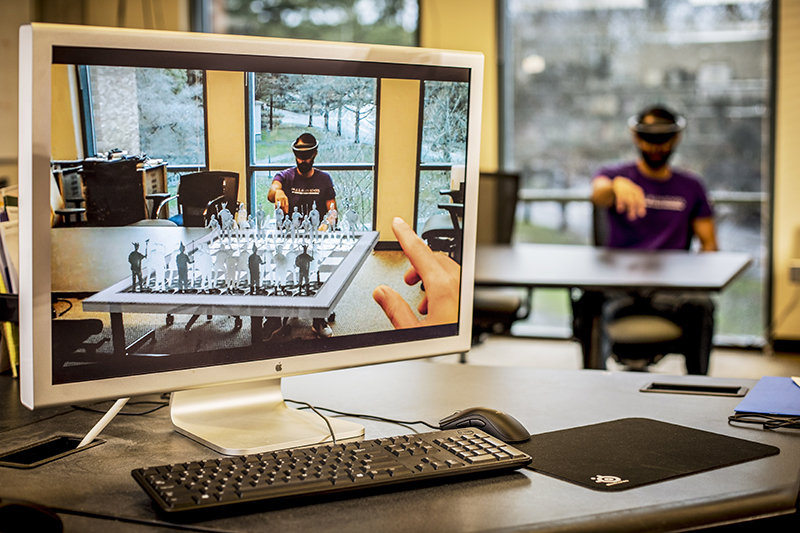
The University of Washington today announced the creation of the UW Reality Lab, a $6 million virtual and augmented reality research lab that was funded by equal contributions from Facebook Inc., Google LLC and Huawei Technologies Co. Ltd.
The lab will be part of the Paul G. Allen School of Computer Science & Engineering in Seattle, which is where Facebook’s Oculus Research team is also located. According to the university, the goal of the UW Reality Lab is to develop new technologies that will push VR and AR beyond niche entertainment application and into the mainstream.
“We’re seeing some really compelling and high-quality AR and VR experiences being built today,” said Steve Seitz, Allen School professor and co-lead of the new research center. “But there are still many core research advances needed to move the industry forward — tools for easily creating content, infrastructure solutions for streaming 3D video and privacy and security safeguards — that university researchers are uniquely positioned to tackle.”
Allen School assistant professor Ira Kemelmacher-Shlizerman, who is also a research scientist at Facebook, will co-lead the UW Reality Lab along with Seitz. “When you think about VR and AR, there are many challenging open problems that we all need to solve to be able to move the field forward,” said Kemelmacher-Shilzerman. “Progress is happening at a rapid pace, but to solve the really hard problems it requires academia and industry to work together.”
The tech giants that invested in the lab have plenty to gain from technology that can give VR a wider appeal. Facebook’s Oculus, which the social media company bought in 2014 for nearly $3 billion, produces both Oculus Rift and Samsung Gear VR. Google launched its Google Daydream mobile VR platform and headset in 2016, and in 2017 Huawei announced that it would produce the first third-party Daydream-compatible headset, Huawei VR.
The University of Washington said the UW Reality Lab will be aided by an advisory board made up of “luminaries from across the AR and VR community.” They include Oculus Chief Scientist Michael Abrash, who said in a statement that Oculus Research is looking forward to working with the lab “to help invent the future.”
Other members of the advisory board include Michael Cohen, director of the Computational Photography Group at Facebook; Paul Debevec, senior researcher at Google Daydream; Shahram Izadi, chief technology officer of PerceptiveIO; Wei Su, senior architect of the Fields Lab at Huawei Seattle Research Center; and Fan Zhang, dead of the Fields Lab.
… We’d like to tell you about our mission and how you can help us fulfill it. SiliconANGLE Media Inc.’s business model is based on the intrinsic value of the content, not advertising. Unlike many online publications, we don’t have a paywall or run banner advertising, because we want to keep our journalism open, without influence or the need to chase traffic.The journalism, reporting and commentary on SiliconANGLE — along with live, unscripted video from our Silicon Valley studio and globe-trotting video teams at theCUBE — take a lot of hard work, time and money. Keeping the quality high requires the support of sponsors who are aligned with our vision of ad-free journalism content.
If you like the reporting, video interviews and other ad-free content here, please take a moment to check out a sample of the video content supported by our sponsors, tweet your support, and keep coming back to SiliconANGLE.






