 EMERGING TECH
EMERGING TECH
EMERGING TECH







EMERGING TECH

Linking a universe of “internet of things” connected devices into a manageable whole is a work in progress to put it optimistically. “An absolute disaster” — analyst Maribel Lopez’s description — would be a less cheerful diagnosis. Could networking legacy Cisco Systems Inc. furnish the missing pieces?
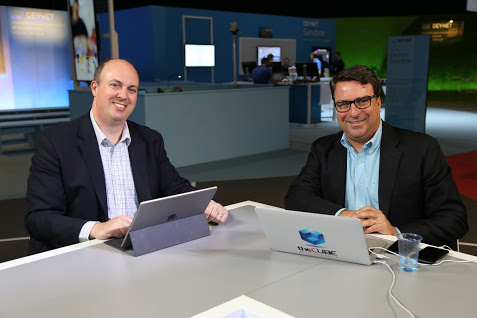
Cisco began hammering away at the IoT concept, which it termed “internet of everything,” a number of years ago. “They had a good vision upfront, but the market needed to mature some, and now we are ready for this to be real,” said Stu Miniman (@stu, pictured, left), co-host of theCUBE, SiliconANGLE Media’s mobile livestreaming studio.
Today, Cisco has to its name a number of recent acquisitions and its own programmable network — Intent-Based Networking — to help solve the IoT puzzle. Miniman and co-host John Furrier (@furrier, pictured, right) surveyed Cisco’s IoT goods at the Cisco Live event in Barcelona, Spain.
At the show’s keynote, Rowan Trollope, senior vice president and general manager of Cisco’s applications, laid out the company’s ambitious IoT mission. “If anything, what I critique a little bit is, he gives the vision of 2050,” Miniman said. “Go to a show like Amazon; they’re like, ‘Hey, builders. Here’s what we have for you today that’s really cool.'”
That said, the company is sallying forward with some ready-to-wear offerings.
In 2016, Cisco completed acquired Jasper Technologies Inc. for $1.4 billion. Jasper is a cloud-based IoT service platform that enables companies to manage IoT at scale. The way Cisco is leveraging Jasper and cellular technology is novel among IoT providers.
“That might be the unique, creative thinking that could bring IoT into IT and transform the highly unsecured IoT-Wi-Fi-IP market,” Furrier said.
It’s Intent-Based Networking is a programmable, smart network that learns and adapts, which can help take the pain out of IoT sprawl. It follows the trend of data-based approach to networking. “They didn’t throw out the kind of AI and ML buzzwords out there, but underneath, that’s what’s happening. It is about data,” Miniman said.
Cisco’s multicloud designs are not as feasible, which should not surprise anyone, given multicloud’s immaturity as a concept, let alone a reality. “I think it’s one of those moonshots down the road. I don’t think anything’s going to happen in multicloud for a while,” Furrier stated.
Cisco appears to have correct bearings in multicloud, however. Its DevNet developer program is pro containers (a virtualized method for running distributed applications) and Kubernetes (an open-source container management platform). It is also working with Google LLC on open-source platform to connect, manage and secure microservices.
“Kubernetes could possibly unlock the multicloud path,” Furrier concluded.
Watch the complete video interview below, and be sure to check out more of SiliconANGLE’s and theCUBE’s coverage of Cisco Live Barcelona 2018.
Support our mission to keep content open and free by engaging with theCUBE community. Join theCUBE’s Alumni Trust Network, where technology leaders connect, share intelligence and create opportunities.
Founded by tech visionaries John Furrier and Dave Vellante, SiliconANGLE Media has built a dynamic ecosystem of industry-leading digital media brands that reach 15+ million elite tech professionals. Our new proprietary theCUBE AI Video Cloud is breaking ground in audience interaction, leveraging theCUBEai.com neural network to help technology companies make data-driven decisions and stay at the forefront of industry conversations.





