



 EMERGING TECH
EMERGING TECH
EMERGING TECH
EMERGING TECH

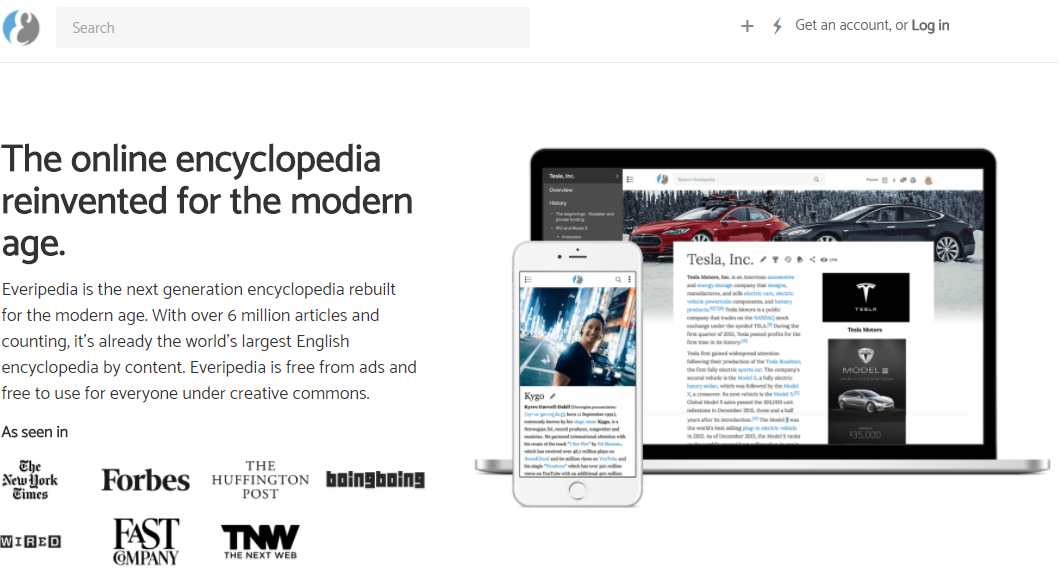
Everipedia Inc., a for-profit Wikipedia competitor, today said it has raised $30 million to move its “next generation encyclopedia” onto a blockchain.
The Series A round was led by Galaxy Digital’s EOS.IO Ecosystem Fund and included the Distributed Network Advisors Fund.
Founded in 2014, Everipedia has been described as “a more lively Wikipedia for the Snapchat generation.” At its base, Everipedia does share similarities with Wikipedia, since it’s wiki-based and editable by users. But with the funding, it’s attempting to move its offering onto a platform based on the distributed ledger technology called blockchain — complete with bitcoinlike tokens, because in 2018, who isn’t?
The investment by Galaxy Digital is fitting because the fund’s founder, Mike Novogratz, a former Wall Street macro trader who recently raised $250 million to trade cryptocurrencies as well as make principal investments, is also a big advocate of the EOS blockchain platform. That’s the very same platform Everipedia is moving onto.
EOS is an Ethereum-based blockchain platform that’s aiming to become a decentralized operating system that can support industrial-scale decentralized applications. Where it differs from traditional blockchains is that it’s promising to remove transaction fees completely, along with providing the ability to conduct millions of transactions per second.
The way Everipedia taps into EOS gets somewhat confusing. On the one hand, there’s a suggestion that the content of the company will be hosted on an EOS-blockchain platform. Larry Sanger, Everipedia’s chief information officer, said in a statement that “this investment will allow us to build the infrastructure for … a global, decentralized, neutral forum that can credibly discover the best of our knowledge.”
On the other hand, the company also talks about using its tokens to reward editors. The concepts are not mutually exclusive, but the messaging is confusing, suggesting Everipedia needs to hire a chief marketing officer to sort it out.
Unfortunately, it gets even more confusing. Apparently Everpidia is planning on issuing its own tokens to owners of EOS tokens. Business Insider explained that the tokens “will be airdropped to holders of EOS — another digital currency. The protocol will make the editing process on the site more transparent” since “token holders who want to make an edit will have to put up a small collateral in order to do so, deterring trolls who would have to pay to make dubious edits to articles. The tokens also give holders voting rights over what is added to the site.”
In any case, one thing that can be said about Everipedia is that the site looks good. Calling it Wikipedia 2.0 might be a stretch, but Sanger is a co-founder of Wikipedia, so referring to it as the next-gen online encyclopedia isn’t a stretch.
… We’d like to tell you about our mission and how you can help us fulfill it. SiliconANGLE Media Inc.’s business model is based on the intrinsic value of the content, not advertising. Unlike many online publications, we don’t have a paywall or run banner advertising, because we want to keep our journalism open, without influence or the need to chase traffic.The journalism, reporting and commentary on SiliconANGLE — along with live, unscripted video from our Silicon Valley studio and globe-trotting video teams at theCUBE — take a lot of hard work, time and money. Keeping the quality high requires the support of sponsors who are aligned with our vision of ad-free journalism content.
If you like the reporting, video interviews and other ad-free content here, please take a moment to check out a sample of the video content supported by our sponsors, tweet your support, and keep coming back to SiliconANGLE.






