



 NEWS
NEWS
NEWS
NEWS
NEWS

The recent Cambridge Analytica scandal has proven that Facebook Inc. has some serious user privacy issues, and Facebook’s public image took another hit last week after reports suggested that it has been logging people’s call and SMS history without permission.
Now, in response to the numerous reports on Facebook’s privacy woes, the U.S. Federal Trade Commission announced that it has launched a probe to investigate how the social network handles user data.
Tom Pahl, acting director of the FTC’s Bureau of Consumer Protection, said today in a statement:
The FTC is firmly and fully committed to using all of its tools to protect the privacy of consumers. Foremost among these tools is enforcement action against companies that fail to honor their privacy promises, including to comply with Privacy Shield, or that engage in unfair acts that cause substantial injury to consumers in violation of the FTC Act. Companies who have settled previous FTC actions must also comply with FTC order provisions imposing privacy and data security requirements. Accordingly, the FTC takes very seriously recent press reports raising substantial concerns about the privacy practices of Facebook. Today, the FTC is confirming that it has an open non-public investigation into these practices.
Facebook’s share values plummeted immediately after the FTC announced its probe, but they rebounded later in the day, closing up a fraction of a point on a day when the overall market rose about 3 percent.
However, public opinion toward the company has not bounced back so easily, and the #deleteFacebook trend has continued to gain momentum. The movement even gained the support of WhatsApp co-founder Brian Acton, who sold his company to Facebook for roughly $19 billion in 2014.
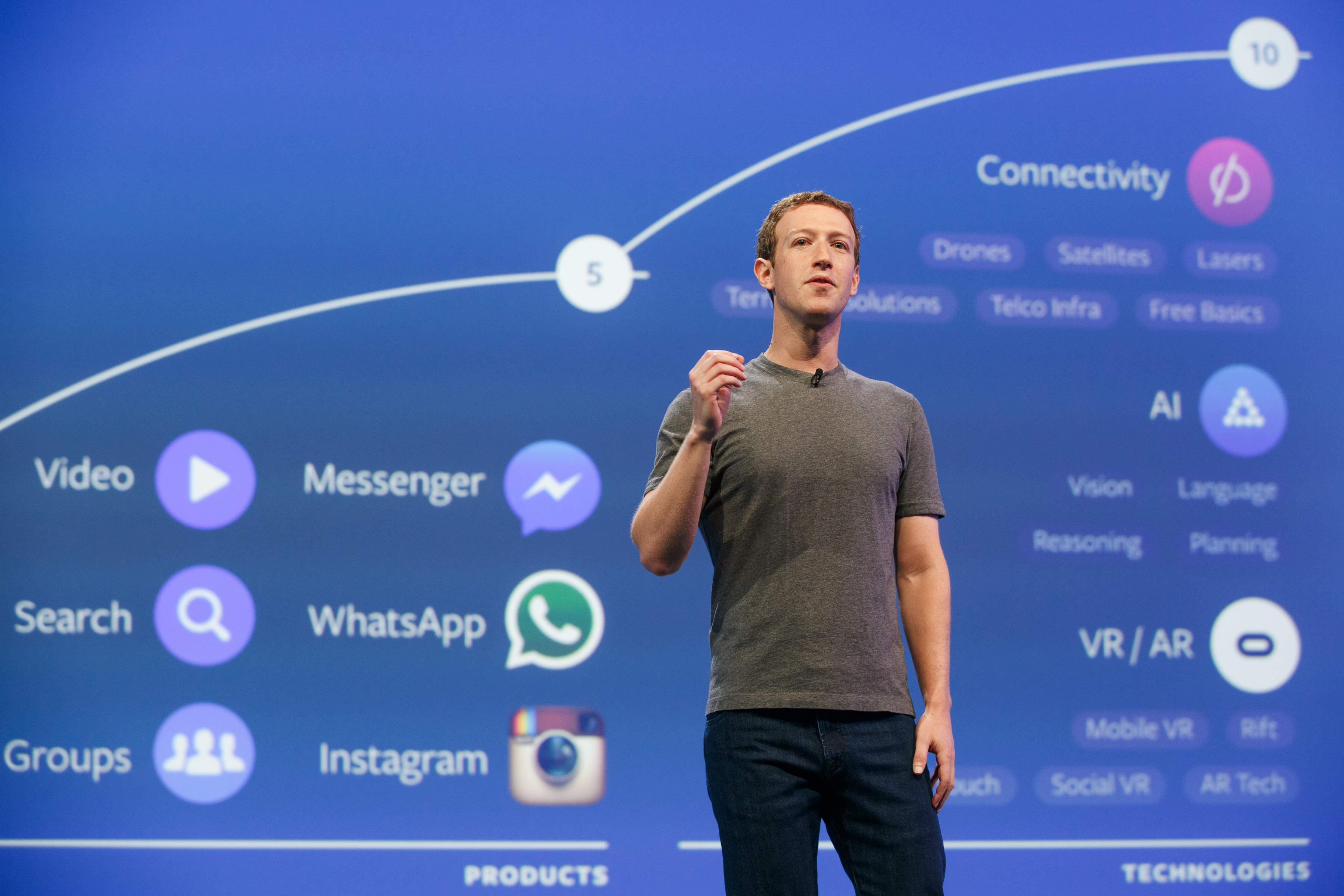
Facebook Chief Executive Mark Zuckerberg (pictured) finally broke his silence on the Cambridge Analytica scandal last week, saying that Facebook must “step up” and address its failures. “We will learn from this experience to secure our platform further and make our community safer for everyone going forward,” Zuckerberg said.
Facebook eventually owned up to Cambridge Analytica’s misuse of user data, but the company has denied the more recent reports that it has been logging users’ call and SMS history without their permission. “This is not the case,” Facebook said in a statement.
To be clear, Facebook does actually log user calls and SMS history on its mobile apps, but the company has rejected the “without permission” element of last week’s reports.
“Call and text history logging is part of an opt-in feature for people using Messenger or Facebook Lite on Android. This helps you find and stay connected with the people you care about, and provides you with a better experience across Facebook,” Facebook said in its statement. “People have to expressly agree to use this feature.”
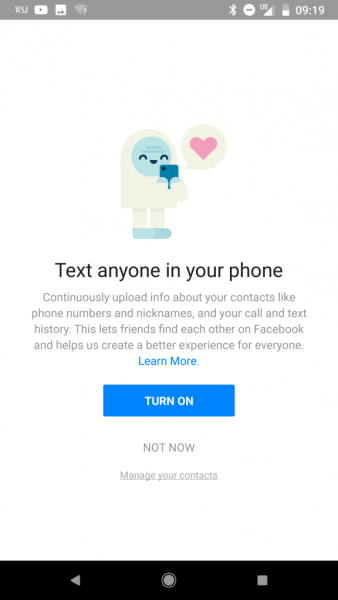
Although Facebook’s call logging feature is opt-in, the prompt given to users during installation offers a seemingly innocuous explanation for what the feature does. The prompt also features “TURN ON” as the more prominent choice, while the easily missed “NOT NOW” is displayed in the same faded gray color as the rest of the text. With the number of people who skip past terms-of-service agreements without ever reading them, it is possible that many users have the call logging feature turned unbeknownst to them.
Facebook assured users that it will never sell the data it has gathered from this feature, and the company noted that the feature “does not collect the content of your text messages or calls.” Facebook also said users can disable the logging feature at any time, which will delete “all previously shared call and text history shared via that app.”
… We’d like to tell you about our mission and how you can help us fulfill it. SiliconANGLE Media Inc.’s business model is based on the intrinsic value of the content, not advertising. Unlike many online publications, we don’t have a paywall or run banner advertising, because we want to keep our journalism open, without influence or the need to chase traffic.The journalism, reporting and commentary on SiliconANGLE — along with live, unscripted video from our Silicon Valley studio and globe-trotting video teams at theCUBE — take a lot of hard work, time and money. Keeping the quality high requires the support of sponsors who are aligned with our vision of ad-free journalism content.
If you like the reporting, video interviews and other ad-free content here, please take a moment to check out a sample of the video content supported by our sponsors, tweet your support, and keep coming back to SiliconANGLE.






