



 CLOUD
CLOUD
CLOUD
CLOUD
CLOUD

Information technology has always been a black and white world where decisions are between option A and option B, experts spend hours arguing over which technology is going to win the supremacy battle, and executives stress over purchasing choices. But in today’s collaborative world you can have it all, at least where containers and virtual machines are concerned.
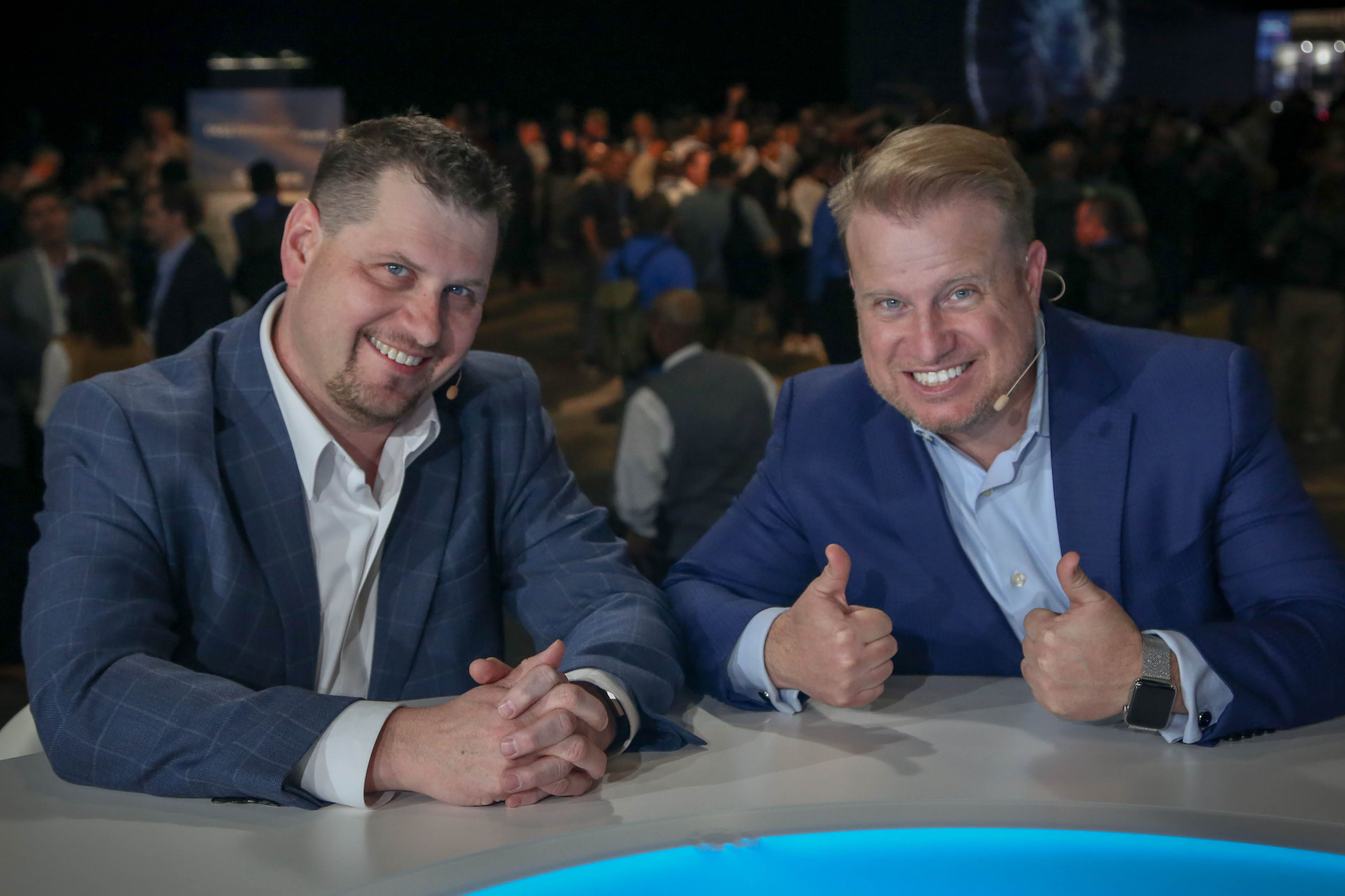
“The reality is that … kernel-mode VMs and containers are going to coexist, and in fact the majority of containers are actually going to be deployed on kernel-mode hypervisors,” said Chad Sakac (pictured, right), Pivotal Container Service and Dell Technology Alliance at Pivotal Software Inc.
Sakac was joined by Chad Dunn (pictured left), vice president of product management and marketing at Dell Technologies Inc., for an interview with Dave Vellante (@dvellante), host of theCUBE, SiliconANGLE Media’s mobile livestreaming studio, and guest host Keith Townsend (@CTOAdvisor) at the Dell Technologies World event in Las Vegas. The discussion centered around the Dell EMC, Pivotal and VMware Inc. alliance and the Pivotal Container Service, aka Pivotal Kubernetes Service (PKS), including some “face-melting” use case examples. (* Disclosure below.)
Whether an enterprise is cloud native, hybrid, or in the process of transformation, the best infrastructure is that which works invisibly and can be adapted intuitively. “[People] want something that is very much automated and very much scale-out so it can react the same way that their application does,” Dunn said.
The job of information technology practitioners and the vendor ecosystem is to make it as easy as possible, according to Sakac. With the Dell EMC VxRail hyperconverged appliance, Pivotal has made an “easy button” based off of the customer standard — the VMware stack. ”So … you can grow your Kubernetes cluster; you can grow your physical infrastructure,” he said. “Easy Kubernetes makes deploying containers easy; however, PKS makes deploying and versioning Kubernetes easy. VxRail makes deploying and versioning the vSphere stack easy.”
“Facemelting” is how Sakac described the use-case benefits of PKS. “If I say I can basically drive all of the platform updates, including the infrastructure, at thousands of stores around the globe, that’s pretty face melting; no one else could do that,” he stated.
Watch the complete video interview below, and be sure to check out more of SiliconANGLE’s and theCUBE’s coverage of the Dell Technologies World 2018 event. (* Disclosure: Dell EMC sponsored this segment of theCUBE. Neither Dell EMC nor other sponsors have editorial control over content on theCUBE or SiliconANGLE.)
… We’d like to tell you about our mission and how you can help us fulfill it. SiliconANGLE Media Inc.’s business model is based on the intrinsic value of the content, not advertising. Unlike many online publications, we don’t have a paywall or run banner advertising, because we want to keep our journalism open, without influence or the need to chase traffic.The journalism, reporting and commentary on SiliconANGLE — along with live, unscripted video from our Silicon Valley studio and globe-trotting video teams at theCUBE — take a lot of hard work, time and money. Keeping the quality high requires the support of sponsors who are aligned with our vision of ad-free journalism content.
If you like the reporting, video interviews and other ad-free content here, please take a moment to check out a sample of the video content supported by our sponsors, tweet your support, and keep coming back to SiliconANGLE.






