 INFRA
INFRA
INFRA
INFRA







INFRA

To pull ahead in intensely competitive Formula 1 racing, teams increasingly leverage technology to fine-tune cars and win races. Safety concerns and the challenge of moving bulky infrastructure around the world present a host of challenges for information technology personnel.
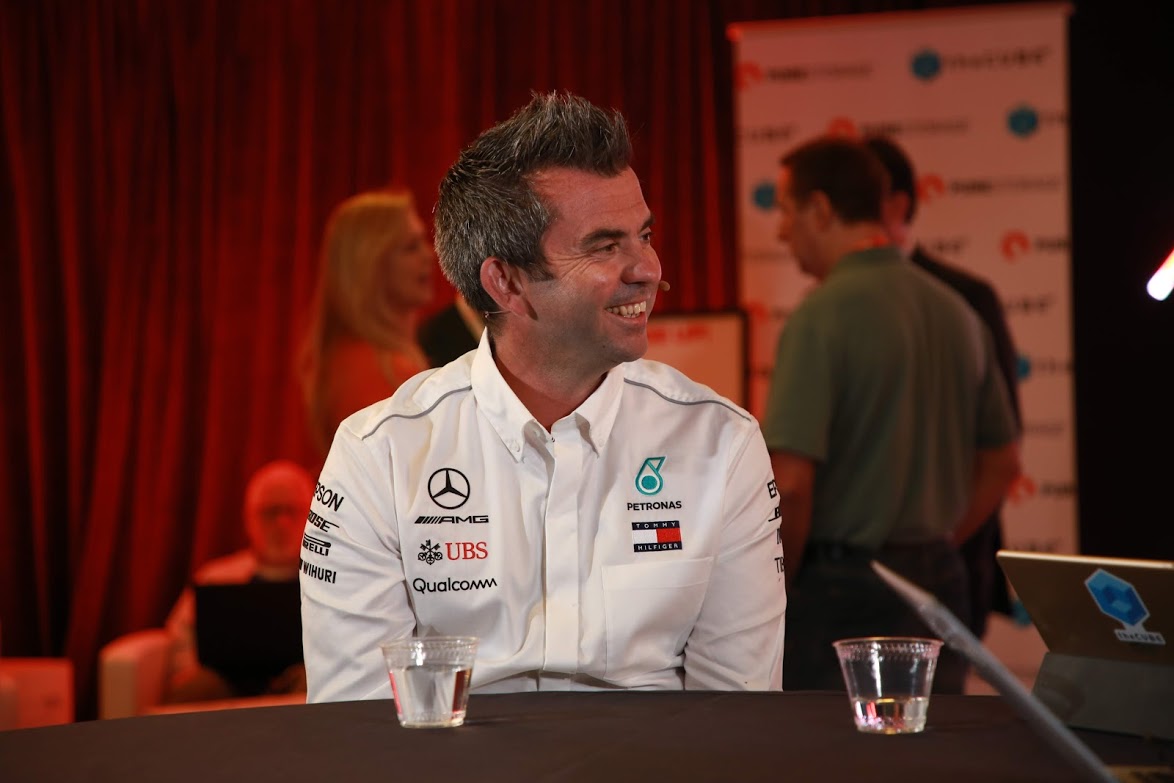
Mercedes-Benz Grand Prix Ltd must set up its data center in 21 different locations per year as it travels from one competition to another. Keeping bulk to a minimum is a top priority, according to head of IT Matt Harris (pictured). In the past, vendors’ requirement that the company purchase extra storage bundled with compute was majorly irritating and wasteful, according to Harris. Along with backup hassles, this is one reason the organization switched over to Pure Storage Inc. about three years ago. It can now purchase stand-alone storage as needed, with no tag-along compute to pay for.
“Everything just got smaller, cheaper,” he said.
Harris spoke with Dave Vellante (@dvellante) and Lisa Martin (@LuccaZara), co-hosts of theCUBE, SiliconANGLE Media’s mobile livestreaming studio, during the Pure Storage Accelerate event in San Francisco. They discussed the challenges of manning a traveling data center and balancing data with human brains for decision making. (* Disclosure below.)
The day-to-day lives of IT pros — trackside and in the factory where engineers perfect race cars — has changed since the switch. “We had a storage guy that was spending his life managing storage. Nobody manages storage now,” Harris said.
Likewise, backup has become a much simpler affair. “We had a guy that was always changing tape. I never want to see a tape archive. I just don’t care about it any longer,” he said.
Mining the data for insights is another bustling area of research and adjustment on the track and in the shop. “We’re not in a position at the moment where the machines are making decisions; they’re helping us to be informed, to visualize,” Harris stated. “The problem that we’ve got at the moment is we’re still looking at all the data. Where we really want to get to is looking at exceptions.”
There is much to glean from analyzing anomalies, but fishing them out of an ocean of data isn’t easy. Machine learning for image recognition, etc., is helping move the ball forward, according to Harris.
Through its partnership with Pure, the organization gets dibs on advanced new tech (for analytics, ML, etc.) six months or so before it goes live, lending it a competitive edge. “Six months is a long time in F1,” Harris concluded.
Watch the complete video interview below, and be sure to check out more of SiliconANGLE’s and theCUBE’s coverage of the Pure Storage Accelerate event. (* Disclosure: TheCUBE is a paid media partner for Pure Storage Accelerate 2018. Neither Pure Storage Inc., the event sponsor, nor other sponsors have editorial control over content on theCUBE or SiliconANGLE.)
Support our mission to keep content open and free by engaging with theCUBE community. Join theCUBE’s Alumni Trust Network, where technology leaders connect, share intelligence and create opportunities.
Founded by tech visionaries John Furrier and Dave Vellante, SiliconANGLE Media has built a dynamic ecosystem of industry-leading digital media brands that reach 15+ million elite tech professionals. Our new proprietary theCUBE AI Video Cloud is breaking ground in audience interaction, leveraging theCUBEai.com neural network to help technology companies make data-driven decisions and stay at the forefront of industry conversations.





