



 EMERGING TECH
EMERGING TECH
EMERGING TECH
EMERGING TECH

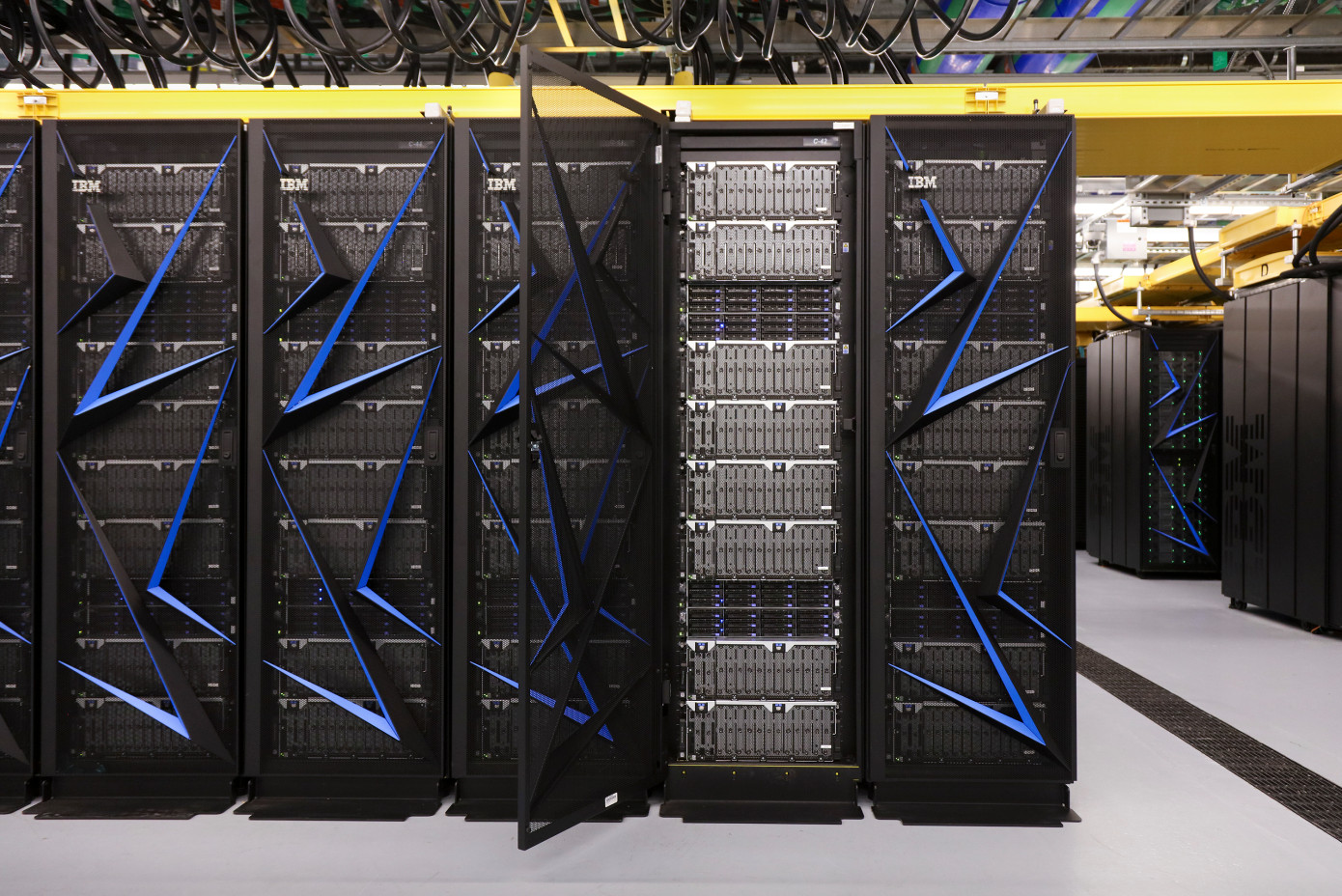
The newest instrument in the Oak Ridge National Laboratory’s scientific arsenal is a mammoth, liquid-cooled supercomputer sprawled over an eighth of an acre that is being hailed as the fastest in the world.
The machine, which goes by Summit, made its official debut today. It was built by IBM Corp. at a cost of $200 million and will support research projects across a variety of fields ranging from medicine to astrophysics.
Summit will put 200 petaflops of processing power at the disposal of the scientists at Oak Ridge. For reference, a single petaflop represents a quadrillion calculations per second. The system can maintain such speeds while crunching large mathematical values based on the 64-bit floating-point format commonly used in supercomputing projects. Performance is reportedly even better for simpler operations.
All this computational power comes from the 4,608 interconnected servers that make up Summit’s backbone. Each node is equipped with two 22-core central processing units supplied by IBM and six of Nvidia Corp.’s Tesla V100 graphic cards. The latter chips have been chosen partially because they are optimized for running artificial intelligence models.
Summit is billed as the first supercomputer built from the ground up with AI in mind. Oak Ridge intends to harness AI for a number of upcoming projects, including an initiative to better understand how genetics influence medical conditions.
The amount of support infrastructure necessary to perform research at such a level is almost as impressive as Summit’s core specifications. According to Oak Ridge, a network of pipes circulates 4,000 gallons of water through the system every minute to keep the servers inside cool. The nodes are also connected by no less than 185 miles of fiber-optic cable.
Oak Ridge expects Summit to become fully operational early next year. The system will provide eight times the processing power as Oak Ridge’s existing Titan supercomputer, as well as 60 percent more than the Chinese machine that has so far held the world record for speed.
Yet while impressive in own right, Summit is part of a much broader vision for the future of computing. The U.S. government is looking to build machines with performance in excess of an exaflop, or 1,000 petaflops. The goal is to have the first such system come online by 2023 at the latest.
Here’s the video of the livestreamed event:
… We’d like to tell you about our mission and how you can help us fulfill it. SiliconANGLE Media Inc.’s business model is based on the intrinsic value of the content, not advertising. Unlike many online publications, we don’t have a paywall or run banner advertising, because we want to keep our journalism open, without influence or the need to chase traffic.The journalism, reporting and commentary on SiliconANGLE — along with live, unscripted video from our Silicon Valley studio and globe-trotting video teams at theCUBE — take a lot of hard work, time and money. Keeping the quality high requires the support of sponsors who are aligned with our vision of ad-free journalism content.
If you like the reporting, video interviews and other ad-free content here, please take a moment to check out a sample of the video content supported by our sponsors, tweet your support, and keep coming back to SiliconANGLE.






