



 EMERGING TECH
EMERGING TECH
EMERGING TECH
EMERGING TECH

An open industry standards body Tuesday announced the development of a new standard for virtual reality headsets that will do away with the multiple connectors and wires required by current VR headsets and replace them with a single cable.
The VirtualLink Consortium consortium includes makers of VR headsets such as Microsoft Inc., Facebook Inc.-owned Oculus Inc. and Valve Corp. as well as video card manufacturers Advanced Micro Devices Inc. and Nvidia Corp.
“At Oculus, we’re committed to making VR easily approachable for a wide variety of people,” said Nate Mitchell, head of Rift at Oculus. “A consolidated connection point is critical in removing barriers to experiencing high-powered PC VR.”
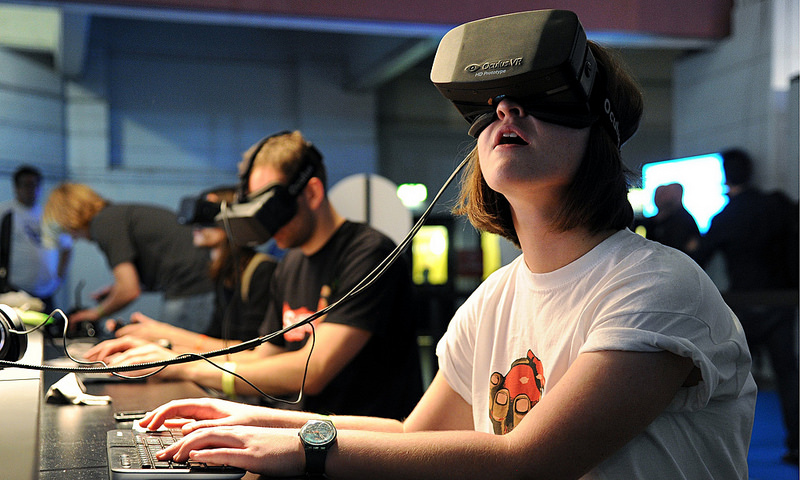
Like most current-generation headsets, Oculus requires three separate cables and connectors to hook up to a PC: two USB 3.0 cables and a high-definition multimedia interface cable. This level of interconnectivity is commonplace for VR devices and makes them cumbersome to use.
VirtualLink’s open standard would replace these multiple cables with a single Alternate Mode Universal Serial Bus Type-C cable. The objective would be to simplify connectivity for VR devices to PCs and make it much easier for consumers to hook up and go.
That would also make it easier for device makers and video card manufactures to develop VR-enabled connectors without the need to worry about a different variety of potentially proprietary connection methods.
“Simulating reality requires incredible visual fidelity and processing power,” said Jason Paul, general manager of gaming and VR at Nvidia. “With a single, high-bandwidth cable, VirtualLink unlocks the full potential of the PC to power amazing VR experiences.”
To make the magic happen, VirtualLink’s open standard proposes a purpose-built cable and connector using the USB 3.1 standard and a Type-C connector – which, in a kindness to users, cannot be inserted incorrectly because it has no orientation.
With the connector, VR headsets will have access to four high-speed DisplayPort lanes, which are scalable for future needs; the USB 3.1 data channel for high-resolution cameras and sensors; and up to 27 watts of power.
The VR headset market saw approximately 1 million headsets shipped in the third quarter of 2017, according to a report from industry analyst Canalys. During that period Sony Corp. shipped 490,000 PlayStation VR sets, Oculus shipped 210,000 Rift headsets and HTC Corp., a partner of Valve, shipped 160,000 Vive VR units.
As an industry, the demand for augmented reality and virtual reality headsets is expected to reach 68.9 units shipped by 2022, according to International Data Corp. During 2017, though, the growth of the industry itself was slow thanks to expensive hardware and sparse overall content to use with VR.
“While there’s no doubt that VR suffered some setbacks in 2017, companies such as Google LLC and Facebook Inc. continue to push hard toward making the technology more consumer-friendly,” said Tom Mainelli, IDC’s vice president of devices and AR/VR research.
During the same year, however, AR and VR companies still managed to raise more than $3 billion in funding and, according to the stats site Statista, the industry is expected to reach $209 billion in revenue in 2022 in a huge boost from an estimated size of $27 billion this year.
VirtualLink’s new open standard would make consumer and enterprise devices less complicated to use by supporting a single cable connection over two or sometimes three that come with current generation headsets. The consortium also announced the upcoming publication of an advanced overview of the VirtualLink 1.0 specification, which will be available to companies and developers with details available at the VirtualLink website.
… We’d like to tell you about our mission and how you can help us fulfill it. SiliconANGLE Media Inc.’s business model is based on the intrinsic value of the content, not advertising. Unlike many online publications, we don’t have a paywall or run banner advertising, because we want to keep our journalism open, without influence or the need to chase traffic.The journalism, reporting and commentary on SiliconANGLE — along with live, unscripted video from our Silicon Valley studio and globe-trotting video teams at theCUBE — take a lot of hard work, time and money. Keeping the quality high requires the support of sponsors who are aligned with our vision of ad-free journalism content.
If you like the reporting, video interviews and other ad-free content here, please take a moment to check out a sample of the video content supported by our sponsors, tweet your support, and keep coming back to SiliconANGLE.






