



 EMERGING TECH
EMERGING TECH
EMERGING TECH
EMERGING TECH

Major tech firms regularly open-source internal software projects, but it’s not often that Oracle Corp.’s name comes up in this context. Today marked one of those occasions.
The database giant this morning released GraphPipe, a tool for easing the deployment of machine learning models. Development on the project was led by Oracle cloud architect Vish Abrams, an open-source veteran who previously worked at NASA as part of the team that created the OpenStack data center operating system.
GraphPipe is intended to address what Abrams described in an announcement as something of a market gap. There are many tools out there for building machine learning models, he wrote, but few that can help developers deploy them. In particular, GraphPipe focuses on simplifying the process of connecting an artificial intelligence to the applications that will use it.
Abrams explained that the mechanisms provided by AI frameworks such as TensorFlow for handling the task are often slow and inefficient. Consequently, many development teams find themselves having to write custom code. But implementing the necessary logic can be difficult because of the complexity of large-scale AI projects.
Enter GraphPipe. The project provides a “standard, high-performance protocol” for transmitting data from a neural network to an application and back. Abrams sees it being particularly useful for complex projects in which a single AI model is used by multiple applications or vice versa.
“If marketing wants to use a model produced by the finance group, they will have to write custom clients to interact with the model. If the model becomes popular [and] sales wants to use it as well, the custom deployment may crack under the load,” Abrams wrote.
He explained that “a standard allows researchers to build the best possible models, using whatever tools they desire, and be sure that users can access their models’ predictions without bespoke code. Models can be deployed across multiple servers and easily aggregated into larger ensembles using a common protocol.”
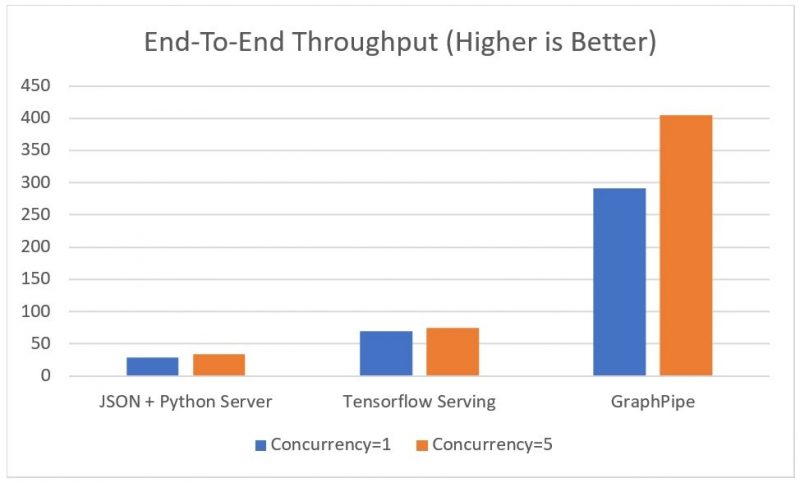
Another big benefit that Oracle touts with GraphPipe is performance. In an internal test conducted by the company, the tool was shown to process requests to an AI model considerably faster than existing methods.
Graphpipe supports five popular AI frameworks on launch: TensorFlow, Microsoft Corp.’s CNTK, PyTorch, mxnet and caffe2. Oracle has made the code available on GitHub alongside a collection of developer resources to help adopters familiarize themselves with the tool.
… We’d like to tell you about our mission and how you can help us fulfill it. SiliconANGLE Media Inc.’s business model is based on the intrinsic value of the content, not advertising. Unlike many online publications, we don’t have a paywall or run banner advertising, because we want to keep our journalism open, without influence or the need to chase traffic.The journalism, reporting and commentary on SiliconANGLE — along with live, unscripted video from our Silicon Valley studio and globe-trotting video teams at theCUBE — take a lot of hard work, time and money. Keeping the quality high requires the support of sponsors who are aligned with our vision of ad-free journalism content.
If you like the reporting, video interviews and other ad-free content here, please take a moment to check out a sample of the video content supported by our sponsors, tweet your support, and keep coming back to SiliconANGLE.






