



 EMERGING TECH
EMERGING TECH
EMERGING TECH
EMERGING TECH

In parallel with Alphabet Inc.’s high-profile work to apply artificial intelligence in healthcare, other tech giants are pursuing their own medical AI projects.
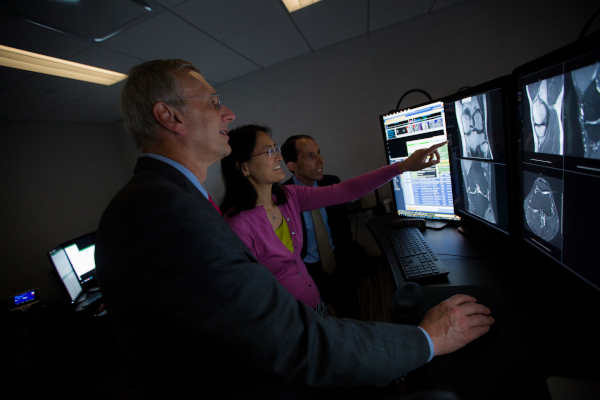
One of the participants in this industry effort is Facebook Inc., which today announced a collaboration with the New York University School of Medicine to harness machine learning for radiology. The partnership’s goal is to make MRI scans up to 10 times faster than they are now.
MRI scans currently take anywhere from 15 minutes to more than an hour, whereas a CT or X-ray machine will produce an image in a matter of seconds. That’s the tradeoff for the higher level of detail the technology can provide for soft tissue such as organs and blood vessels. According to Facebook, speeding up the scanning process would provide a raft of benefits for patients.
To start, hospitals in rural areas and other regions with a limited number of MRI machines could cut wait times. On an individual level, reducing the amount of time a patient has to spend inside the scanner could ease the experience if they’re claustrophobic or suffer from poor health. Should Facebook and NYU manage to make MRI scans fast enough, the technology might even become a viable alternative to CT or X-ray, which emit more radiation.
But there’s much work to be done before that can before a reality. Facebook and NYU’s approach to the challenge involves reducing the amount of data that MRI machines must collect for an image. The plan is to perform “accelerated” scans and have an AI fill in the missing details, much like what the human brain does when processing partial information such as a dimly lit object.
Training a machine learning to perform the task will require a great deal of sample data. To that end, NYU has collected approximately 3 million knee, brain and liver scans for the project that had been anonymized beforehand to comply with healthcare data regulations.
Facebook has high hopes. In a blog post, the company’s researchers pointed out prior NYU research that showed AI models was capable of completing partial images “from far less data than was previously thought to be necessary.” But they stressed that implementing the approach outside the lab will be difficult.
“In practice, reconstructing images from partial information poses an exceedingly hard problem,” they wrote. “A few missing or incorrectly modeled pixels could mean the difference between an all-clear scan and one in which radiologists find a torn ligament or a possible tumor. Conversely, capturing previously inaccessible information in an image can quite literally save lives.”
Facebook and NYU expect to publish initial results within a year. They plan to open-source the project, including everything from the AI models to the sample MRI dataset, in the interest of enabling other parties to contribute. The social network’s researchers wrote that the technology produced as part of the collaboration might eventually be applied to speeding up not just MRI scans but also other forms of medical imaging.
… We’d like to tell you about our mission and how you can help us fulfill it. SiliconANGLE Media Inc.’s business model is based on the intrinsic value of the content, not advertising. Unlike many online publications, we don’t have a paywall or run banner advertising, because we want to keep our journalism open, without influence or the need to chase traffic.The journalism, reporting and commentary on SiliconANGLE — along with live, unscripted video from our Silicon Valley studio and globe-trotting video teams at theCUBE — take a lot of hard work, time and money. Keeping the quality high requires the support of sponsors who are aligned with our vision of ad-free journalism content.
If you like the reporting, video interviews and other ad-free content here, please take a moment to check out a sample of the video content supported by our sponsors, tweet your support, and keep coming back to SiliconANGLE.






