



 CLOUD
CLOUD
CLOUD
CLOUD
CLOUD

Whether gaming, streaming video, or summoning a self-driving car, the digital data thrown off by the influx of online users is driving up network traffic demands. Connected devices have created a networked “edge” to the world of cloud computing, revealing a new frontier for technologies optimized at the software level to take on the range of exploratory use cases.
To truly push data to the edge and back requires significant processing power, but software-defined wide area network technology helps abstract away complexities of tying legacy WAN to modern applications. SD-WAN moves the control layer to the cloud, which virtualizes and centralizes how the network is managed by remote administrators. Boosted by the acquisition of VeloCloud last November, VMware Inc.’s virtualization portfolio hopes to differentiate in a market expected to reach $8 billion by 2021.
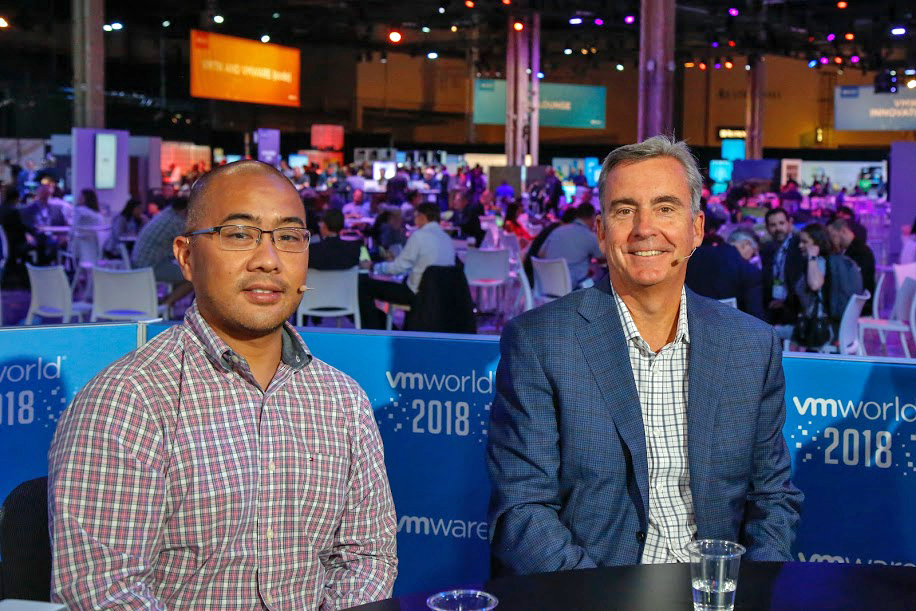
“SD-WAN is the enablement of creating virtual network functions, the elimination of proprietary hardware and technology, simplifying choice, but also helping to provide all that connectivity, pushing more … of the processing to the edge and closer to the branch,” said Tom Burns (pictured, right), senior vice president and general manager of networking and solutions at Dell Technologies Inc.
Burns and Jason Chan (pictured, left), senior director of global network services at Dell Technologies, spoke with Stu Miniman (@stu), co-host of theCUBE, SiliconANGLE Media’s mobile livestreaming studio, and guest host Justin Warren (@jpwarren), chief analyst at PivotNine Pty Ltd., during the VMworld conference in Las Vegas, Nevada. They discussed the progress of VMware’s SD-WAN-ready products and its significance as part of the larger Dell EMC family. (* Disclosure below.)
The benefit of SD-WAN architecture applies to computing environments separated by geographical distance, including Dell’s own 300 branch office locations supporting 12 global data centers and seven manufacturing locations, operated by 140,000 team members, comprising what Chan calls Dell’s “SD-WAN sweet spot.”
Dell spent over two years building up to its current network virtualization initiatives, working closely within its own ecosystem of network carrier and other partners and awaiting the right time to marry EMC’s computing power with VeloCloud’s software-led advantage.
Released in April of this year, Dell EMC’s Virtual Edge Platform (VEP4600) is meant to enhance or displace expensive, fixed-function access hardware. “We’re using [VEP4600] as the foundation, from a universal [custom premises equipment] … to virtualize a lot of network functions,” Chan said.
This method addresses the networking challenge of remotely managing data from an endpoint owned by a third party, playing into the broader burden of managing data crossing multicloud environments. To centralize control and secure moving data, Dell is shifting away from the traditional routers, physical boxes for firewalls, and putting everything into one box, according to Chan.
Instead of policing what end users access via corporate-owned networks, Dell now sees SD-WAN as an avenue to freeing enterprises from restricting end-device data based on cost analyses and security concerns. This freedom is one of three trends Chan attributes to the rapid growth of SD-WAN products, with software services and increasing network demands also driving interest.
Dell has a very “generous” use policy when it comes to video-streaming, according to Chan. “You can stream videos, right or wrong,” he said. Even if the number of employees remains level at a company, the amount of data they generate within a corporate network increases with every scroll of a Facebook News feed.
“With SD-WAN we’re actually breaking that mold because we tied that to their legacy [tech],” said Chan, noting Dell’s dynamic and secure options for addressing the high cost of multiprotocol label switching (MPLS) transport for branch locations accessing the internet across MPLS connections.
Watch the complete video interview below, and be sure to check out more of SiliconANGLE’s and theCUBE’s coverage of the VMworld conference. (* Disclosure: Dell Technologies Inc. sponsored this segment, with additional broadcast sponsorship from VMware Inc. Dell, VMware, and other sponsors do not have editorial control over content on theCUBE or SiliconANGLE.)
… We’d like to tell you about our mission and how you can help us fulfill it. SiliconANGLE Media Inc.’s business model is based on the intrinsic value of the content, not advertising. Unlike many online publications, we don’t have a paywall or run banner advertising, because we want to keep our journalism open, without influence or the need to chase traffic.The journalism, reporting and commentary on SiliconANGLE — along with live, unscripted video from our Silicon Valley studio and globe-trotting video teams at theCUBE — take a lot of hard work, time and money. Keeping the quality high requires the support of sponsors who are aligned with our vision of ad-free journalism content.
If you like the reporting, video interviews and other ad-free content here, please take a moment to check out a sample of the video content supported by our sponsors, tweet your support, and keep coming back to SiliconANGLE.






