



 SECURITY
SECURITY
SECURITY
SECURITY

Continuing its pivot away from its traditional smartphone market and into cybersecurity, BlackBerry Ltd. announced its biggest acquisition ever this morning, picking up security firm Cylance Inc. for $1.4 billion in cash.
Cylance, which focuses on manufacturing and “internet of things” applications, will operate as an independent business unit. But BlackBerry said it will quickly fold the company’s technology into its QNX unit, which makes software for autonomous vehicles.
The Irvine, California-based company, founded by two former executives of Intel Corp.’s McAfee software subsidiary, uses artificial intelligence technology to detect threats that don’t match known attack signatures. The company has raised nearly $300 million and was said to be a close to an initial public offering when BlackBerry swooped in.
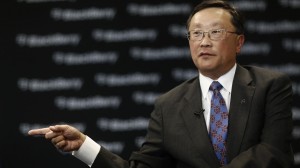
BlackBerry, which once dominated the smartphone industry but was overwhelmed by more functional iOS- and Android-based devices, has shifted its focus toward IoT and autonomous vehicles in particular under Chief Executive John Chen (pictured), who was appointed in 2013. The company exited the smartphone business entirely two years ago. Its principal products today are Spark, which creates trusted connections between endpoints, and QNX, which is used to develop embedded applications.
“We have 120 million cars using BlackBerry technology, in particular, QNX,” Chen said on a conference call. “We’re going to introduce Cylance into that space.”
The combined companies will have more than $1 billion in software revenue, he said. BlackBerry cited a recent Gartner survey that found that security was the top barrier to IoT success, with 35 percent of technology executives calling it a concern.
Cylance’s approach to security uses mathematical models rather than signatures to detect breaches and compromises. The approach is well-suited to IoT applications because it relies on local intelligence rather than software updates. “Signatures don’t work,” said Cylance co-founder and CEO Stuart McClure. “They’re defined by that which we know. The only way to detect today’s attacks is with predictive learning.”
Cylance’s technology is “completely autonomous of the cloud,” McClure said. “We can install in an offshore oil rig and never need an uplink.” Some of the company’s products have been running for 18 months without a connection, he added.
The deal is expected to close by the end of February.
… We’d like to tell you about our mission and how you can help us fulfill it. SiliconANGLE Media Inc.’s business model is based on the intrinsic value of the content, not advertising. Unlike many online publications, we don’t have a paywall or run banner advertising, because we want to keep our journalism open, without influence or the need to chase traffic.The journalism, reporting and commentary on SiliconANGLE — along with live, unscripted video from our Silicon Valley studio and globe-trotting video teams at theCUBE — take a lot of hard work, time and money. Keeping the quality high requires the support of sponsors who are aligned with our vision of ad-free journalism content.
If you like the reporting, video interviews and other ad-free content here, please take a moment to check out a sample of the video content supported by our sponsors, tweet your support, and keep coming back to SiliconANGLE.






