



 EMERGING TECH
EMERGING TECH
EMERGING TECH
EMERGING TECH

For a market that didn’t exist a couple years ago, the nascent autonomous delivery market is certainly drawing a lot of investor interest.
Nuro Inc., a startup looking to use self-driving vehicles to pick up groceries for consumers, today announced that it has closed a staggering $940 million investment from SoftBank Group Corp.’s Vision Fund. The round reportedly gives it a valuation of $2.7 billion. It has raised a total of more than $1 billion from SoftBank, Greylock Partners and Gaorong Capital.
Mountain View, California-based Nuro was founded in 2016 by Dave Ferguson and Jiajun Zhu, two veterans of Google LLC parent Alphabet Inc.’s self-driving car initiative. They worked on the project as principal engineers before the search giant spun it off into an independent business unit. Aurora Innovation inc., an autonomous driving startup led by another veteran of Alphabet’s self-driving car initiative, last week raised a $530 million funding round of its own.
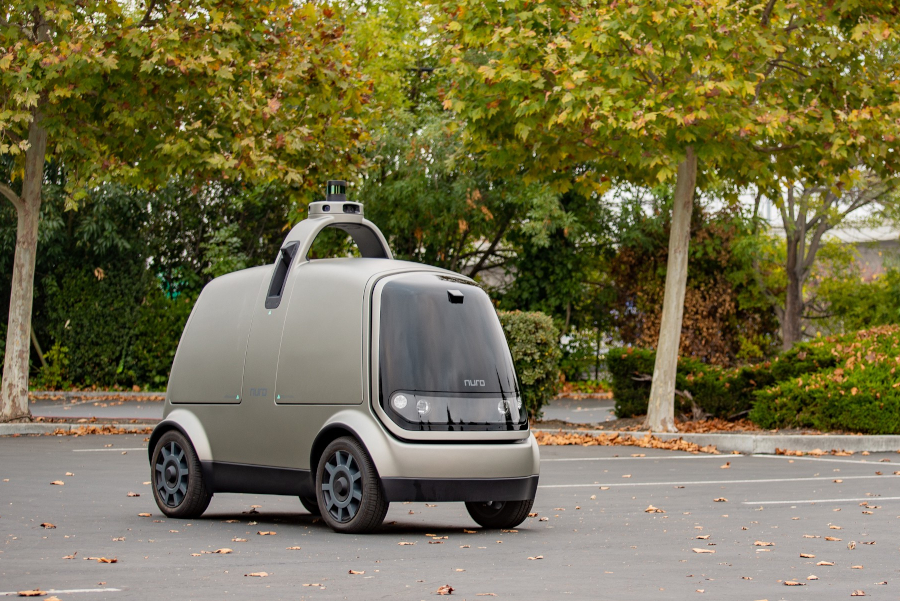
In contrast with Aurora, which is taking a somewhat secretive approach with its efforts, Nuro hasn’t shied away from the industry spotlight. The startup made headlines last year when it announced a partnership with Kroger Co. to pilot an autonomous delivery service in Scottsdale, Arizona. After initially using Toyota Prius hybrids to ferry groceries to buyers, Nuro expanded the fleet in December with an internally developed robot dubbed the R1.
It’s about half the size of a car and has two storage compartments with space for three shopping bags each. This makes the vehicle larger than most of the other delivery robots on the market, including Amazon.com’s recently unveiled Scout rover.
Another point that sets the R1 apart is the fact that it travels on the road instead of the sidewalk. The robot can cruise at a maximum speed of 25 miles per hour, which enables it to cover short distances relatively quickly while retaining the ability to stop nearly instantaneously when the need arises. It’s also fairly lightweight, which further reduces potential risks to vehicles and pedestrians.
This safety-conscious design is a big part of the reason Nuro managed to put a delivery robot on the road in just a couple of years. The R1’s small size and modest speed means it can make do with less sophisticated sensors than those self-driving cars require to safely navigate the road, which saved a great deal of time.
Nuro claimed in mid-December that it has completed 1,000 deliveries as part of the pilot with Kroger. It will use the $940 million from SoftBank to expand its fleet of delivery robots and expand into new geographic areas, as well as add more partners to support the effort.
The startup’s long-term vision isn’t limited to grocery delivery. Nuro recently licensed some of its technology to a fellow startup called Ike Robotics Inc. that’s working on self-driving trucks, a signal it may be eyeing revenue opportunities in the auto industry.
… We’d like to tell you about our mission and how you can help us fulfill it. SiliconANGLE Media Inc.’s business model is based on the intrinsic value of the content, not advertising. Unlike many online publications, we don’t have a paywall or run banner advertising, because we want to keep our journalism open, without influence or the need to chase traffic.The journalism, reporting and commentary on SiliconANGLE — along with live, unscripted video from our Silicon Valley studio and globe-trotting video teams at theCUBE — take a lot of hard work, time and money. Keeping the quality high requires the support of sponsors who are aligned with our vision of ad-free journalism content.
If you like the reporting, video interviews and other ad-free content here, please take a moment to check out a sample of the video content supported by our sponsors, tweet your support, and keep coming back to SiliconANGLE.






