



 EMERGING TECH
EMERGING TECH
EMERGING TECH
EMERGING TECH

The U.S. Department of Energy has tapped Intel Corp. to build a massive new supercomputer that will surpass the capabilities of even the most powerful systems currently in existence.
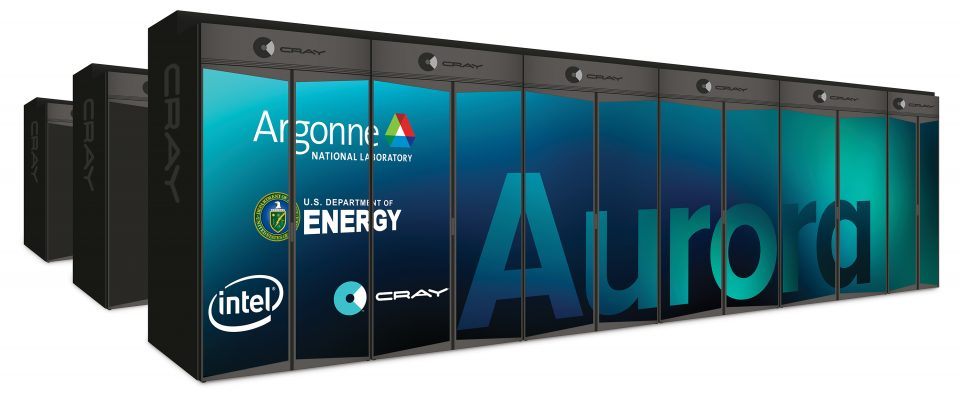
The chipmaker said today that the planned system, dubbed Aurora, will provide an entire exaflop of performance when it comes online in 2021.
An exaflop equals a quintillion floating point operations per second, which is expressed as one followed by 18 zeros. That’s five times the maximum number of computations per second that can be carried out on the world’s fastest supercomputer, which is also operated by the Department of Energy.
The agency has budgeted more than $500 million for the construction of Aurora. Intel will develop the system in collaboration with supercomputer manufacturer Cray Inc. using its yet-unreleased next generation processors as building blocks.
The company will base Aurora on an unspecified future iteration of its Xeon central processing units, which dominate the market for server processors. Intel also plans to equip the system with the Xe series of graphics processing units that it’s aiming to release next year. Little is known about the Xe series other than the fact that the chips will use a 10-nanometer architecture.
The DoE’s decision to rely on Intel GPUs in Aurora represents a valuable endorsement for the company. When it launches next year, the Xe series will face off against products from Nvidia Corp. and Advanced Micro Devices Inc., which have maintained a duopoly in the graphics card market for two decades now. The inclusion of Xe chips in what may end up being the world’s most powerful supercomputer may make it a little easier for Intel to convince potential buyers
Besides the upcoming chips, Aurora will also make use of two other yet-unreleased Intel technologies. One is a future iteration of its Optane DC persistent memory, while the other is the Intel One application programming interface that the company previewed in December. The API aims to simplify the development of applications that use both CPUs and GPUs.
Intel will deliver Aurora to the Department of Energy’s Argonne National Laboratory in Chicago. The agency plans to harness the system for a wide variety of research applications, from testing the effectiveness of drugs to generating “extreme-scale” cosmological simulations.
The U.S. isn’t the only country that has set out to break the exaflop barrier. Japan’s RIKEN research institute and Fujitsu Ltd. are aiming to build their own exascale system by 2021 using ARM-based chips.
… We’d like to tell you about our mission and how you can help us fulfill it. SiliconANGLE Media Inc.’s business model is based on the intrinsic value of the content, not advertising. Unlike many online publications, we don’t have a paywall or run banner advertising, because we want to keep our journalism open, without influence or the need to chase traffic.The journalism, reporting and commentary on SiliconANGLE — along with live, unscripted video from our Silicon Valley studio and globe-trotting video teams at theCUBE — take a lot of hard work, time and money. Keeping the quality high requires the support of sponsors who are aligned with our vision of ad-free journalism content.
If you like the reporting, video interviews and other ad-free content here, please take a moment to check out a sample of the video content supported by our sponsors, tweet your support, and keep coming back to SiliconANGLE.






