



 CLOUD
CLOUD
CLOUD
CLOUD
CLOUD

IBM Corp. beat first-quarter net income estimates today but disappointed investors with a larger-than-expected decline in quarterly revenue, sending its stock down more than 3% in after-hours trading.
The company blamed delayed decision-making in the Asia-Pacific region for the shortfall and continued to back away from talk of growth, focusing instead on profitability metrics. It maintained its full-year guidance of $13.90 per share. Update: Shares were down nearly 4% in Wednesday trading.
Chief Financial Officer James Kavanaugh said company had a “strong” quarter but admitted stumbles.
“We had a good pipeline during the quarter and, based upon client buying decisions, did not execute,” he said. “But we got off to a a solid start and that gives us confidence in maintaining our guidance.” The pending acquisition of Red Hat Inc., which is expected to close in the second quarter, isn’t included in full-year guidance.
Adjusted quarterly earnings of $2.25 per share slightly edged out consensus estimates of $2.22. Revenue fell nearly 5% from a year ago, to $18.18 billion, below consensus estimates of $18.47 billion.
Revenue declined or barely grew in nearly every major area of IBM’s business, including Cognitive Solutions (up 2% in constant currency), Global Business Services (up 4%), Global Technology Services (down 3%) and Systems (down 9%). The exception was cloud platforms, where IBM declined to give quarterly figures but said its total cloud business is now a $19.5 billion annual business that grew 10 percent over the past 12 months.
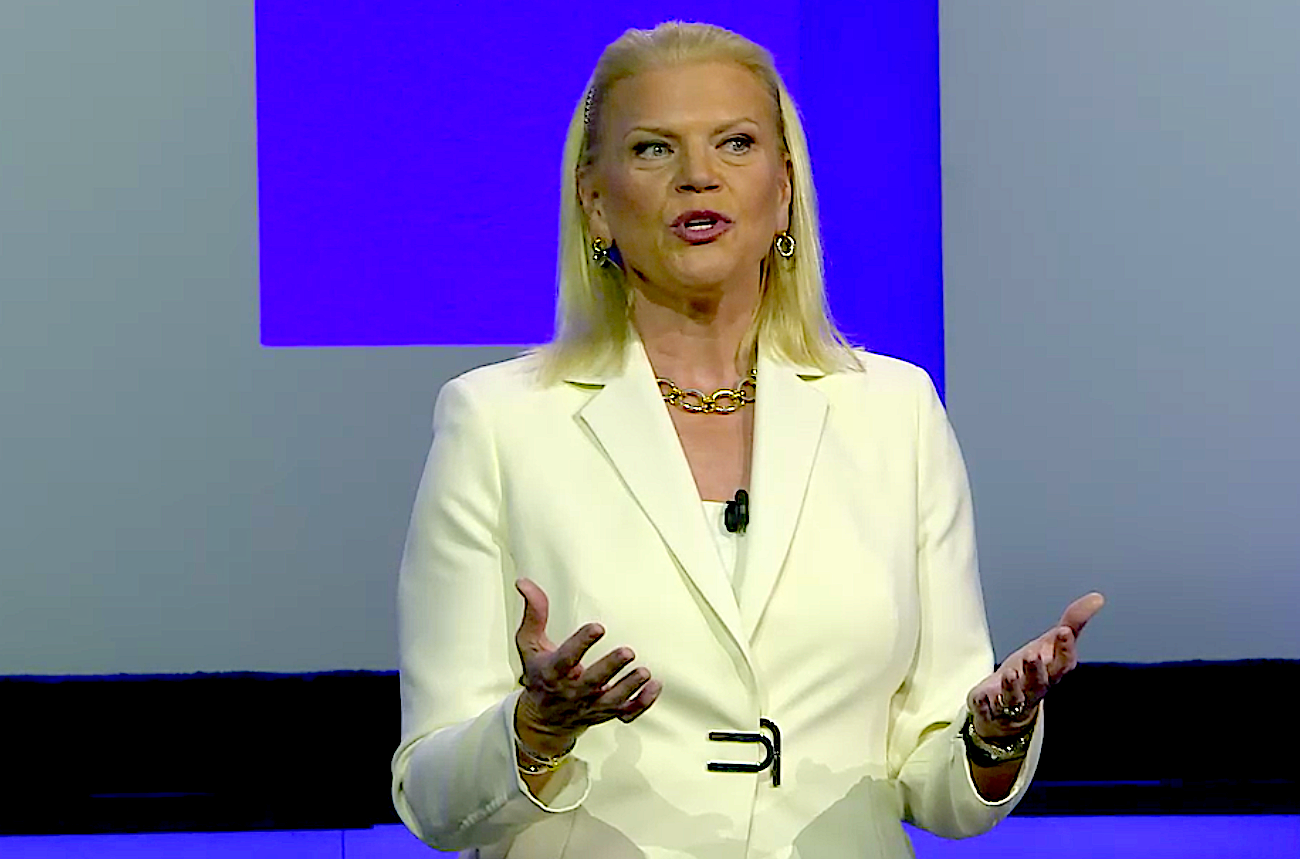
Although that growth continues to lag that of the largest public cloud providers, the $19.5 billion figure is “quite a change from the 4% of company revenues that cloud represented when Ginni Rometty (pictured) became IBM’s CEO,” said Charles King, president and principal analyst at Pund-IT Inc.
IBM long ago stopped trying to win in the public cloud market, instead focusing its efforts on hybrid cloud, multicloud and the estimated 80% of enterprise workloads that have yet to shift to the cloud. “The company has greater experience and deeper multicloud offerings than many of its competitors,” King said.
Systems revenues were particularly impacted by a 38% drop in revenue for the z-series mainframe line, which is nearing the end of its traditional two-year product cycle. The decline was somewhat offset by what IBM said was the sixth consecutive quarter of growth in the company’s Power systems line, although it provided no details.
After showing three straight quarters of revenue growth following more than two years of quarterly declines, IBM is shrinking again, but the company isn’t seeking to perpetuate the myth of a return to high growth. “We’re managing this business around margins, profits and cash,” Kavanaugh said.
On that front, it’s mostly delivering on expectations. Gross profit margins grew 1% led by a 2.8% improvement in margins for GBS, which is the company’s lowest-margin business. Pretax operating margins grew 3.2%.
“This is the strongest gross margin we’ve had in years,” Kavanaugh said. “We see the fundamentals of our business model playing out in terms of growth in key high-value areas, whether it be cloud, security, digital and the data/artificial intelligence. We are also delivering strong operating leverage.”
IBM has been deemphasizing low-margin and original equipment manufacturer business in favor of more profitable engagements. It’s also betting more heavily on its services arms, in particular GTS, which is involved in 90% of its enterprise contracts, Kavanaugh said.
While the quarterly numbers were unimpressive, the company said it has a healthy services pipeline. “IBM’s services backlog is now at $112 billion, with more than 30% in cloud engagements,” King said. “That bodes well for the future.”
In a notable shift from previous earnings reports, IBM didn’t include financial results for its so-called “strategic imperatives,” or the high-growth businesses that it expects to reshape the company. Kavanaugh said breaking out those numbers is no longer relevant, since they constituted more than half of the company’s 2018 revenue. “The feedback we got from you and investors is that the strategic imperatives metric is past its course,” he said.
… We’d like to tell you about our mission and how you can help us fulfill it. SiliconANGLE Media Inc.’s business model is based on the intrinsic value of the content, not advertising. Unlike many online publications, we don’t have a paywall or run banner advertising, because we want to keep our journalism open, without influence or the need to chase traffic.The journalism, reporting and commentary on SiliconANGLE — along with live, unscripted video from our Silicon Valley studio and globe-trotting video teams at theCUBE — take a lot of hard work, time and money. Keeping the quality high requires the support of sponsors who are aligned with our vision of ad-free journalism content.
If you like the reporting, video interviews and other ad-free content here, please take a moment to check out a sample of the video content supported by our sponsors, tweet your support, and keep coming back to SiliconANGLE.






