



 APPS
APPS
APPS
APPS
APPS

Updated:
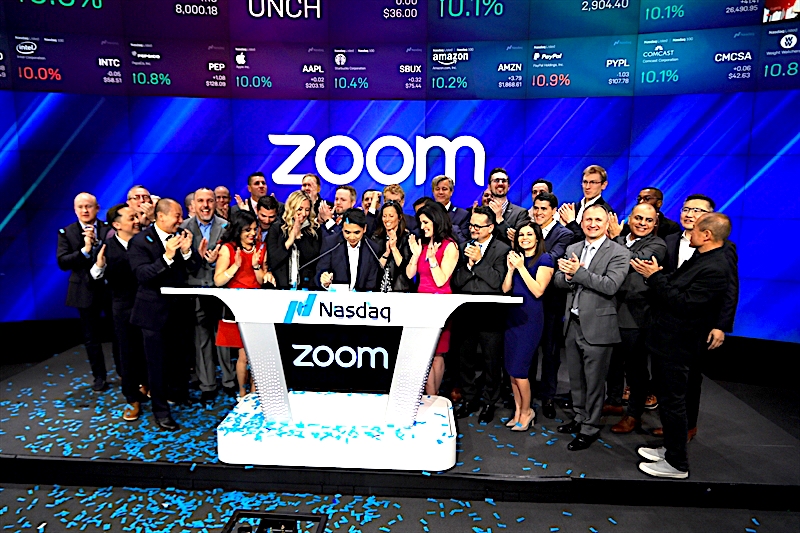
Zoom Video Communications Inc. and Pinterest Inc. both saw their shares pop this morning after each completed initial public offerings in a continuing stream of tech IPOs this year.
The new offerings were seen as a major test of investor appetite for tech IPOs, and at least for now, they passed with flying confetti. Zoom’s shares shot up more than 80% over the initial $36 offering price, to more than $65 a share. Pinterest’s pop was more modest but still a sizable 25% from the $19 offering price, to open at $23.75 a share.
Although both are considered tech companies, each business is quite a different creature, even if they’re both known as unicorns thanks to their billion-dollar-plus valuations. Zoom offers videoconferencing primarily focused on enterprise users, whereas Pinterest is a scrapbooking site come social network with more than 250 million users.
Both are chasing similar valuations on debut as well. Zoom’s initial price was a significant jump over its previous price guidance of $28 to $32 per share, raising $356.8 million and valuing the company at $9.2 billion — now $16.7 billion after the much higher open. Pinterest’s $19 initial price was up from an initial range of $15 to $17 per share, raising $1.43 billion on a valuation of $10 billion, now up to $12 billion at the open Thursday.
The two companies’ stock performance over the next few days and weeks will be watched as a harbinger of other big tech companies planning to go public in coming months — in particular ride-hailing giant Uber Technologies Inc. The IPO, expected to happen next month, likely will be the largest at least in the U.S. this year, with plans to raise about $10 billion on a valuation of $100 billion.
Pinterest and Zoom may offer starkly different perspectives on IPO prospects if only because their financial results differ quite a bit. Pinterest enters the market having booked $755.9 million in revenue last year with a $63 million loss, while Zoom is among a rare breed of tech companies going public, reporting a profit of $7.6 million last year on revenue of $330.5 million.
Both enter public markets as skepticism abounds following the dismal performance of Lyft Inc. after its debut March 28.
Lyft’s shares initially popped 9%, but they dropped below their IPO price on their second day of trading. Although some accusations of market manipulation have been bandied about, the stock continues to wallow. Lyft shares were trading at $59.51 at the close of trading today, down 17% from its IPO price of $72 per share.
Because of Lyft’s performance, Kaltbaum Capital Management President Gary Kaltbaum is warning investors to be cautious about the IPOs given that what happened with Lyft.
“They overpriced it, whoever did the deal made a huge mistake and the fact that it is way below even the IPO price is telling,” Kaltbaum told Fox Business. “I would just be on the careful side right at this second.”
Although the pops mean both companies, especially Zoom, left money on the table that they could have pocketed with higher initial offering prices, neither is likely to be hurting for funds now.
In any case, as companies like to say, the IPO is a beginning, not an end, and for its part, Zoom hewed to that line in an interview Thursday with SiliconANGLE. “The fundamentals will be the same,” said Oded Gal, Zoom’s head of products. In particular, the company plans to introduce more kinds of communications with a goal of disrupting the so-called unified communications market. “We really want to move forward and use our edge in technology.”
Gal also said that beyond continuing to expand on all fronts, acquisitions are a possibility, though he said, “We don’t have any concrete plans so far.”
With reporting from Robert Hof
… We’d like to tell you about our mission and how you can help us fulfill it. SiliconANGLE Media Inc.’s business model is based on the intrinsic value of the content, not advertising. Unlike many online publications, we don’t have a paywall or run banner advertising, because we want to keep our journalism open, without influence or the need to chase traffic.The journalism, reporting and commentary on SiliconANGLE — along with live, unscripted video from our Silicon Valley studio and globe-trotting video teams at theCUBE — take a lot of hard work, time and money. Keeping the quality high requires the support of sponsors who are aligned with our vision of ad-free journalism content.
If you like the reporting, video interviews and other ad-free content here, please take a moment to check out a sample of the video content supported by our sponsors, tweet your support, and keep coming back to SiliconANGLE.






