 SECURITY
SECURITY
SECURITY
SECURITY

The ransomware used to cripple the City of Baltimore last month did not include code from the U.S. National Security Agency’s leaked EternalBlue hacking exploits, according to a security analyst.
The finding comes from Joe Stewart, a malware analyst now consulting with security firm Armor Defense Inc. Krebs on Security reported today that he was unable to find any evidence of EternalBlue code in the Robbinhood ransomware used in the attack.
“We took a look at it and found a pretty vanilla ransomware binary,” Stewart said. “It doesn’t even have any means of spreading across networks on its own.” Stewart did note that it is possible that EternalBlue could have been used to propagate the ransomware but it’s “not terribly likely.”
Stewart’s analysis contradicts a report from The New York Times May 26 which claimed that the EternalBlue exploits were used in the attack targeting Baltimore. That report referenced the finding to Thomas Rid, a cybersecurity expert at Johns Hopkins University.
Rid has yet to comment publicly on the new report claiming that EternalBlue was not involved in the attack, but he’s currently writing a book called “Active Measures: The Secret History of Disinformation and Political Warfare.”
The NSA has never confirmed the existence of EternalBlue but denied any involvement in the attack targeting Baltimore, via a Maryland congressman May 31.
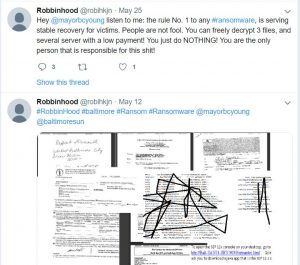 In another twist to the story, Eric Sifford, a security researcher at Armor published a separate report that claimed the entity behind the ransomware attack on Baltimore was seemingly taunting the city’s mayor on Twitter.
A Twitter account going by the name of @robinkjn, which has since been suspended, sent out a series of tweets to Bernard C. Jack Young that included documents that may have been stolen in the attack.
“One of the documents indicates that it has been scanned/copied on May 4, 2019 and pertains to a June 2018 court case where the mayor and City Council of Baltimore City are being sued by an individual,” Sifford wrote. “The other document appears to have been copied/scanned on April 23, 2019 and pertains to a worker’s comp medical file which went to the City of Baltimore.”
Sifford cautioned that the person or persons behind the account may have been a malicious prankster, although the evidence would indicate otherwise.
… We’d like to tell you about our mission and how you can help us fulfill it. SiliconANGLE Media Inc.’s business model is based on the intrinsic value of the content, not advertising. Unlike many online publications, we don’t have a paywall or run banner advertising, because we want to keep our journalism open, without influence or the need to chase traffic.The journalism, reporting and commentary on SiliconANGLE — along with live, unscripted video from our Silicon Valley studio and globe-trotting video teams at theCUBE — take a lot of hard work, time and money. Keeping the quality high requires the support of sponsors who are aligned with our vision of ad-free journalism content.
If you like the reporting, video interviews and other ad-free content here, please take a moment to check out a sample of the video content supported by our sponsors, tweet your support, and keep coming back to SiliconANGLE.