 AI
AI
AI
AI






AI

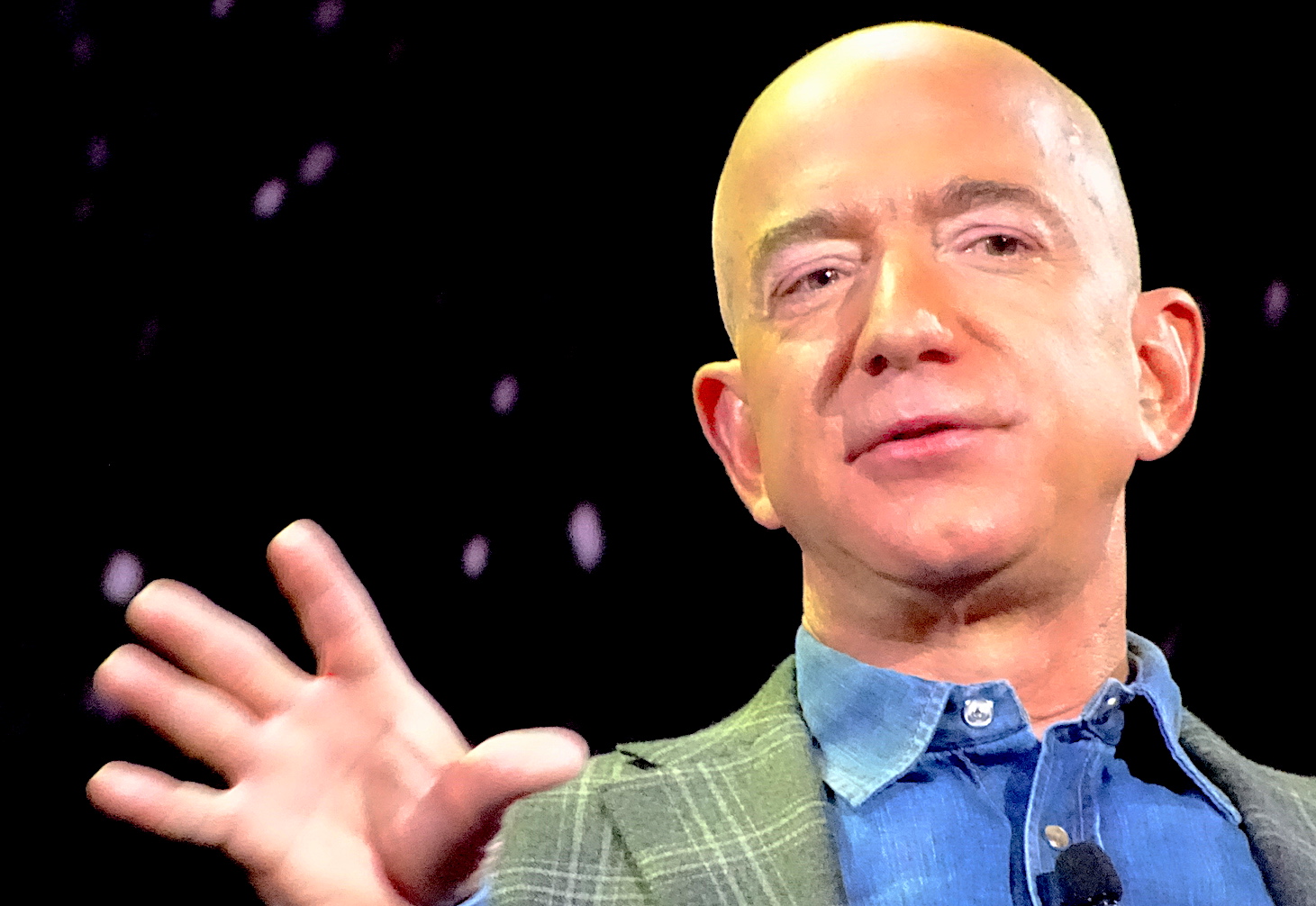
In a rather rare public appearance, Amazon.com Inc. founder and Chief Executive Jeff Bezos provided no news but offered up a few of his well-honed tips for creating and building successful businesses at a “fireside chat” today.
The only exciting moment at the retail and tech giant’s re:MARS conference in Las Vegas was when a protester bounded on the stage to confront Bezos about whether the company would change treatment of chickens supplied to Amazon, though it was difficult for most of the audience to hear any details. She was hustled offstage by security, and Bezos declined to address her concern.
In a brief conversation with with Jenny Freshwater, Amazon’s director of forecasting and capacity planning, Bezos offered a rundown of business advice that he has often given before, though arguably his methods are hardly universal even now.
Asked about his penchant for liking people who are “right” a lot, Bezos admitted that asking people to be right isn’t very helpful, so he defined the traits of people who are often right. “People who are right a lot listen a lot,” he said. “They also change their mind a lot. Even without getting some new data. They wake up and they reanalyze things all the time. The world is so dynamic that if you don’t change your mind a lot, you’re going to be wrong a lot.”
Not least, “they would very hard to discipline themselves to avoid biases. This is very unnatural for human beings.”
Bezos also delved into the way Amazon folks settle on an idea to pursue, mentioning the well-known policy of “Disagree and commit” to move projects along even in the face of skepticism on a team.
“Often I’ll be the one who disagrees and commits,” he said. “I say when I disagree that ‘you have to gamble with me on this.’”
Returning to another favorite approach, he declined to offer much on what’s coming in the next 10 years, not least because such long-term predictions are usually wrong. Instead, he said, it’s more important and useful to figure out what’s not going to change in the next 10 years.
“The answer to that tells you what to work on,” he said. “Like in e-commerce, people will want low prices, fast delivery, large selection. When you identify those big ideas that are stable in time — these are customer needs” that won’t change anytime soon.
Most of all, Bezos emphasized the importance of making big bets, such as Amazon’s own Project Kuiper to put satellites into low Earth orbit to provide worldwide broadband internet connectivity.
Another big bet for Bezos that’s getting a lot of play at re:MARS — which stands roughly for machine learning, automation, robotics and space — is his own Blue Origin space company. He outlined plans for Blue Moon, a lunar lander that he hopes will be the start of tapping resources — in particular water that could be used to make rocket propellent so rockets could be launched from the much lower-gravity moon.
“Logistically it’s a good place to go,” he said. “We need to move… heavy industry off Earth, which will be zoned residential and light industry.”
But most of all, he noted, the infrastructure for a true space industry needs to be built. There’s nothing like the postal services and payment systems that allowed Amazon to launch and grow so quickly. “Today you can’t start a space company in your dorm room,” he said.
Asked if Amazon will have distribution centers on the moon, he quipped, “We’ll start out delivering liquid hydrogen and liquid oxygen. It’ll be a small selection but very important.”
Capping the advice to entrepreneurs was an exhortation to keep taking risks. “You gotta have something that might not work… or the idea has probably already been done,” he said.
Indeed, he added, “we need big failures in order to move the needle. We need billion-dollar failures.”
And all this doesn’t just apply to startups, he added. “You could be at a Fortune 500 company.”
Support our mission to keep content open and free by engaging with theCUBE community. Join theCUBE’s Alumni Trust Network, where technology leaders connect, share intelligence and create opportunities.
Founded by tech visionaries John Furrier and Dave Vellante, SiliconANGLE Media has built a dynamic ecosystem of industry-leading digital media brands that reach 15+ million elite tech professionals. Our new proprietary theCUBE AI Video Cloud is breaking ground in audience interaction, leveraging theCUBEai.com neural network to help technology companies make data-driven decisions and stay at the forefront of industry conversations.





