







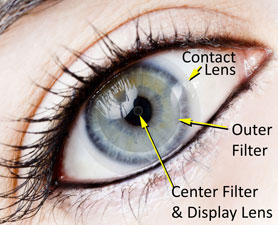
 Innovega, the company that brings the digital world closer to your eyes, has been tapped by The Pentagon to deliver a fully functioning prototype of contact lenses that uses their iOptiks system.
Super lenses
The contact lens features two different filters to allow the wearer to focus on two things at the same time. It is designed to be used in conjunction with heads up display (HUD) units like Google’s Project Glass.
Theoretically, the lens should work like this: the central part of each lens sends light from the HUD towards the middle of the pupil, while the outer part sends light from the surrounding environment to the pupil’s rim. This would then project information onto the glasses’ lenses and the more distant view that can be seen through them.
“Normally, for example, with a camera you focus on something distant or something close – but you focus on a particular spot,” Innovega’s chief executive Steve Willey said. “By wearing our contact lens you automatically have this multi-focus, or dual-focus, and you are doing something that humans don’t usually do.”
Meant for war and gamers
At present, the US Army and Air Force have already deployed bulkier HUDs for use in the field. It will be used to superimpose data about targets and other status updates over the users’ views. But because of their size, they aren’t exactly ideal battle gears.
Innovega’s lenses and a sleek HUD like the Google Project Glass may just be what Pentagon is looking for to help troops enhance their awareness on the battlefield.
Innovega also added that their lenses could be used for augmented reality purposes to make watching movies or playing games as lifelike as possible.
The lenses are being tested by the US Food and Drug Administration, but Innovega is quite positive that the lenses would be approved, and will be commercially available to the public by 2014.
Motion sickness anyone?
Using multifocal lenses may sound really futuristic and cool but unfortunately, multifocal lenses was proven problematic when used to treat post-surgery cataract patients.
“Two superimposed images tend to be degraded and lower in contrast,” said Prof Gary Rubin from University College London’s Institute of Ophthalmology. “I question whether a multifocal contact lens is the right solution.”
“If you’re walking around with a heads up display on, the image projected on the lens could mask your peripheral or central vision. And if it’s magnifying the image or changing the way it moves when your eyes move, you could get motion sickness,” Rubin added.
It’s the price we pay for futuristic technology, as there’s always a bit of give and take with early models and early adopters. There’s countless implications for multifocal contact lenses, but the matter of bringing it to market is another story.
Support our mission to keep content open and free by engaging with theCUBE community. Join theCUBE’s Alumni Trust Network, where technology leaders connect, share intelligence and create opportunities.
Founded by tech visionaries John Furrier and Dave Vellante, SiliconANGLE Media has built a dynamic ecosystem of industry-leading digital media brands that reach 15+ million elite tech professionals. Our new proprietary theCUBE AI Video Cloud is breaking ground in audience interaction, leveraging theCUBEai.com neural network to help technology companies make data-driven decisions and stay at the forefront of industry conversations.




