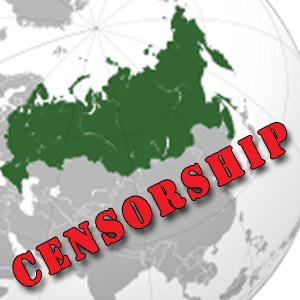







 Wednesday, the Russian parliament unanimously adopted a controversial bill that would give them a tremendous amount of control over the Internet. Not so ironically, Wednesday was also October 31st—Halloween—the day of the year that the horrors, specters, and ghouls walk the land (in costume) and in this fashion, Russia managed to costume up SOPA and bring it to their people.
A multitude of open-interest websites banded together to warn against this bill and its potential for becoming a tool of censorship—amid those sites included Yandex, LiveJournal, Mail.ru, and the Russian-language Wikipedia.
Not just echoes of censorship—actual blatant “secret” censorship
According to the BBC, the bill would create an Internet blacklist, which would not be made public (meaning that the Russian public wouldn’t even know what was being banned or why.)
If the websites themselves cannot be shut down, internet service providers (ISPs) and web hosting companies can be forced to block access to the offending material.
The list of banned website will be managed by Roskomnadzor (Russia’s Federal Service for Supervision in Telecommunications, Information Technology and Mass Communications). It is meant to be updated daily, but its contents are not available to the general public.
Of course, this has drawn the attention of critics who don’t like the idea of web censorship, and are even less enthusiastic about the bill’s portion that keeps the lists hidden from the public. Not only have numerous websites come out against it, but so have human rights organizations who see the obvious gateway to abuse.
It’s less about thinking of the children and more about shaming critics
As The Guardian UK explains, the bill was pushed through on the back of one of the modern day political hot-button issues that are so often used to divest people of safety and privacy: “the protection of children.” Much like how “terrorism” is used to bypass thoughtful and rational discourse on cybersecurity bills. To this extent the phrase “think of the children,” is often used to disparage politicians forwarding controversial or flawed bills to control speech. Apparently, Russia is no stranger to this effect.
“The need to fight child pornography and illegal content are as important for civil society as the support of constitutional principles like freedom of speech and access [to] information,” Yelena Kolmanovskaya, the chief editor of Yandex, wrote in a statement posted on the website on Wednesday. However, she added: “The proposed methods provide a means for possible abuse and raise numerous questions from the side of users and representatives of internet companies.”
Due to Russia’s cultural proximity to Europe, the moment people started to criticize the bill because of the prominent flaws and potential for corruption, the bill’s co-author, Yelena Mizulina, whipped out the go-to accusation and called critics “paedophiles.”
“The online community initiated the need for adopting this law themselves, that’s why I’m sure not all of the online community is against it – just certain circles that can be associated with the paedophilia lobby,” she said, the Interfax news agency reported.
Critics of the bill get called pedophiles, but the provisions of the bill itself will do nothing
Of course, even with daily updates there’s no way that Russia will be able to block any website that interest citizens want to visit.
Perhaps the Russian parliament should look at their next door neighbors and see what happened with The Pirate Bay and the UK High Court’s dalliance with website blocking—needless to explain: it didn’t have the intended effect. Even the Great Firewall of China has holes, customers can hide their traffic with VPN or Onion routers, and with a government pushing this sort of thing it may just drive the citizens to be smarter about hiding their online activity.
Support our mission to keep content open and free by engaging with theCUBE community. Join theCUBE’s Alumni Trust Network, where technology leaders connect, share intelligence and create opportunities.
Founded by tech visionaries John Furrier and Dave Vellante, SiliconANGLE Media has built a dynamic ecosystem of industry-leading digital media brands that reach 15+ million elite tech professionals. Our new proprietary theCUBE AI Video Cloud is breaking ground in audience interaction, leveraging theCUBEai.com neural network to help technology companies make data-driven decisions and stay at the forefront of industry conversations.





