







 Kendo UI, a division of Telerik that offers a comprehensive framework for building JavaScript and HTML5 websites and mobile apps, announced the results of the survey they conducted among 4,000 respondents which consisted of developers for PHP, Java, Ruby, .NET, Node, and many others types. The survey focused on developers’ perspectives and adoption trends around HTML5.
The survey revealed HTML5 adoption and usage trends are on the rise for both mobile and desktop applications., despite recent controversy surrounding HTML5’s capabilities and claims that it is overhyped. The survey showed that 94 percent of developers are actively developing with HTML5 today or are planning to do so by the end of this year while 63 percent are already using the technology today.
Broad adoption of HTML5 will drive a strategic need for tools
“With this kind of broad market support, interest and adoption of HTML5, it’s really important that enterprises have a solution for rapid platform shift in that environment,” says Telerik’s Vice President of HTML5 Web and Mobile Tools, Todd Anglin. Enterprises and developers need to start arming their development crews with the tools to take advantage of the rise of HTML5. The survey only helps corroborate the expectation that HTML5 is now the king of mobile.
If the above numbers haven’t been enough to convince people of this conclusion, the survey didn’t stop there.
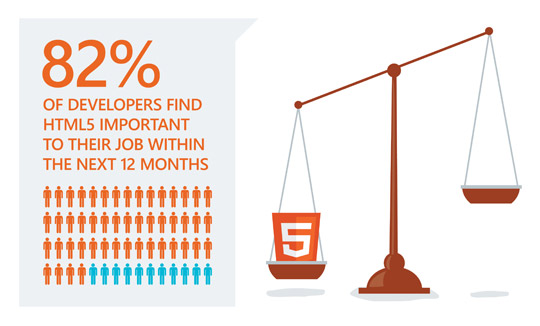
Eighty two percent of developers claim that HTML5 is important for their job immediately or in the next 12 months, while another 13 percent say that it will be important in the coming 12 to 24 months. This contradicts with other industry research reports, such as the Gartner Hype Cycle for Emerging Technologies (2012), which pushed widespread HTML5 adoption 5 to 10 years into the future. Six percent of developers who claim to have no plans for HTML5 in 2012 noted that it will be important to them in the next 12-24 months.
The survey also revealed that 73 percent of developers aren’t bothered by Facebook’s decision to rewrite their HTML5 mobile iPhone app to use mostly native codes stating it has had “little to no impact” on their confidence on the future of HTML5 adoption. In essence, most developers were entirely nonplussed by the announcement from Facebook–in fact, most developers were unaware that Facebook was using HTML5 in their mobile apps. This tends to underscore how effective HTML5 is in doing what native apps already do for consumers without losing any of the traits fundamentally desired by them.
HTML5 rapidly becoming the definitive king of the mobile web
“There has never been before in software a platform as well supported as HTML5, everyone from Adobe to Microsoft, and the like are seen giving support to this platform,” Anglin said about the subject. If anything, HTML5 adoption has been moving more than just apace, it’s become a major factor As a result, it’s very hard to project the adoption and impact of this platform because it’s inching its way into every business and enterprise that uses front end development.
Anglin believes that HTML5 has a lot of sheer adoption momentum and analysts will likely start to recognize this in 2013. He also stated that one of the challenges HTML5 is facing in its future is that the “constants” used to predict industry trends. There may need to be a shift in how analysts predict trends before that recognition comes to see the light of day.
Last September, Telerik announced a major update to Kendo UI that added support for tablet U and server-side wrappers for ASP.NET MVC to enable developers to quickly build rich, native-like, and simplify development of HTML5 and JavaScript mobile apps and sites.
Contributing authors: Mellisa Tolentino and Kyt Dotson
Support our mission to keep content open and free by engaging with theCUBE community. Join theCUBE’s Alumni Trust Network, where technology leaders connect, share intelligence and create opportunities.
Founded by tech visionaries John Furrier and Dave Vellante, SiliconANGLE Media has built a dynamic ecosystem of industry-leading digital media brands that reach 15+ million elite tech professionals. Our new proprietary theCUBE AI Video Cloud is breaking ground in audience interaction, leveraging theCUBEai.com neural network to help technology companies make data-driven decisions and stay at the forefront of industry conversations.





