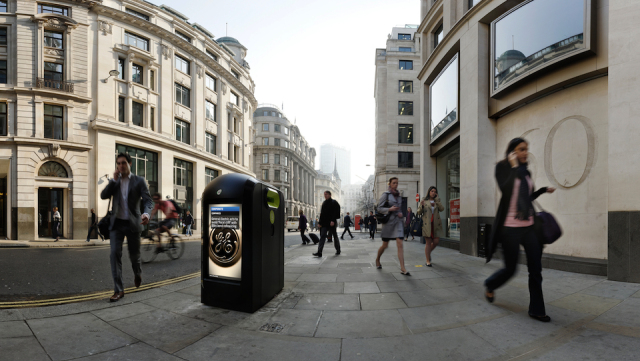







 In London, a busy street lined with recycling bins might seem fairly innocuous at first. But these recycling bins are no ordinary bins – instead, they’ve been equipped with tracking capabilities with the sole purpose of, well, keeping track of people.
During the 2012 Olympics, a startup company called Renew scattered its recycling bins throughout London and caused quite a stir, because these bins with rather hi-tech compared to your usual refuse collection points – these ones had digital screens on them. The purpose of these digital screens was to bombard passers by with advertising. Advertisers can buy space on the internet-connected bins, while the city receives 5 percent of the airtime for free.
Seems pretty cool huh? But cool is about to get creepy, for Renew has just hit upon a way to help brands deliver more targeted ads to people as they walk past its bins, and it does so by tracking their smartphones. In the busy street of Cheapside, which is lined with retail stores, Renew has just outfitted a dozen of these connected recycling bins with trackers that are able identify people through their smartphones. The tracking gadgets record the MAC address, a unique identifier assigned to network interfaces for communications on the physical network segment of smartphones that have their WiFi turned on.
Just one month after installing the trackers in the recycling bins, Renew stated that they were able to pick up over a million unique devices, with July 6 marking a record day for the company. On that day, the bins were able to identify 106,629 people, taking note of their presence 946,016 times. Aside from that, they were able to determine that spikes in traffic occur during commutes and lunch.
 Renew still has a long way to go before it can start pushing ads to people’s smartphones themselves, as it still needs to make retailers see the benefit of targeted ads. Kaveh Memari, CEO of Renew, stated in an interview with Quartz that he is working on a proposal to equip a bar with at least five tracking devices: one for the entrance, one at the register, one on the roof, and for male and female restrooms. This would allow the establishment to see which gender frequents their bar the most, if they prefer to dine in or drink outside, how long people stay and other details that could help the establishment know more about their patrons. The trackers in the bar can be connected to the recycling bin trackers, which means the bar could send a passing patron a special promo when he passes by a recycling bin enabled with the tracking technology.
If you don’t want to be tracked, all you need to do is turn off your smartphone’s WiFi when passing by Cheapside, but even this avenue of ‘escape’ might soon be blocked. Rather creepily, memari stated that everyone will be tracked sooner or later.
“The chances are, if we don’t see you on the first, second, or third day, we’ll eventually capture you,” Memari said. “We just need you to have it on once.”
If you think this sounds all too familiar, it’s because you’ve already seen or heard about it. This isn’t the first time trackers have been used to learn more about people and eventually push out targeted ads.
Brendan O’Connor’s CreepyDOL works in the same kind of way, though it hasn’t been used to track people, but who’s to say that it won’t be in future?
Retailers such as Nordstrom and Target also used some form of tracking to learn about their customers but shoppers weren’t too keen on these efforts. Though some do not mind that their online purchases are being tracked, many customers are worried by the fact that their purchases are being tied to their faces.
Support our mission to keep content open and free by engaging with theCUBE community. Join theCUBE’s Alumni Trust Network, where technology leaders connect, share intelligence and create opportunities.
Founded by tech visionaries John Furrier and Dave Vellante, SiliconANGLE Media has built a dynamic ecosystem of industry-leading digital media brands that reach 15+ million elite tech professionals. Our new proprietary theCUBE AI Video Cloud is breaking ground in audience interaction, leveraging theCUBEai.com neural network to help technology companies make data-driven decisions and stay at the forefront of industry conversations.





