







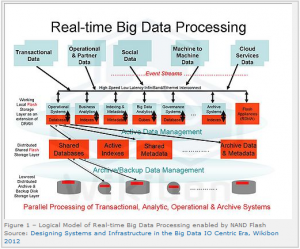
 Xflash, low-latency (microsecond to nanosecond) server SAN storage (LoLaSeS) storage, is the last unfilled segment of the NAND flash market, writes Wikibon Co-founder and CTO David Floyer in “Enabling Real-time Big Data Processing with Xflash – Very Low Latency Server SANs.” This architecture combines RDMA over Infiniband for extremely high bandwidth networking over very short distances, reduced network protocols and the 1 millisecond read/write times and high IO of flash arrays to deliver sub-microsecond IO latency and billions of IOPS. This turns the array into an eXtension of memory, or Xflash.
The two early leaders in the segment are Fusion-IO, the first to demonstrate atomic writes to a flash array, a key technology for Xflash, and EMC, which recently purchased ScaleIO. Atomic writes replace the much slower n-phase commit structure of SCSI, a major component of network latency. HP and Fusion-IO have contributed an Atomic Writes API to the T10 SCSI Storage Interfaces Technical Committee for standardization. Floyer writes that it is being used in mainstream MySQL databases such as the latest versions of MariaDB and Percona Server.
Wikibon predicts that NAND flash will be the dominant non-volatile memory (NVM) in enterprise computing for the next five years and beyond. Other NVRAM technologies such as MRAM, ReRAM & PCM do not offer sufficient performance advantages to warrant their much higher costs. Unless some new technology replaces NAND flash in the high-volume consumer market that is unlikely to change in the foreseeable future.
As with all Wikibon research, this Professional Alert is available publicly on the Wikibon Web site. IT professionals are invited to register to join the Wikibon community, which allows them to post questions, comments, tips, and their own Alerts and white papers on relevant subjects.
Support our mission to keep content open and free by engaging with theCUBE community. Join theCUBE’s Alumni Trust Network, where technology leaders connect, share intelligence and create opportunities.
Founded by tech visionaries John Furrier and Dave Vellante, SiliconANGLE Media has built a dynamic ecosystem of industry-leading digital media brands that reach 15+ million elite tech professionals. Our new proprietary theCUBE AI Video Cloud is breaking ground in audience interaction, leveraging theCUBEai.com neural network to help technology companies make data-driven decisions and stay at the forefront of industry conversations.




