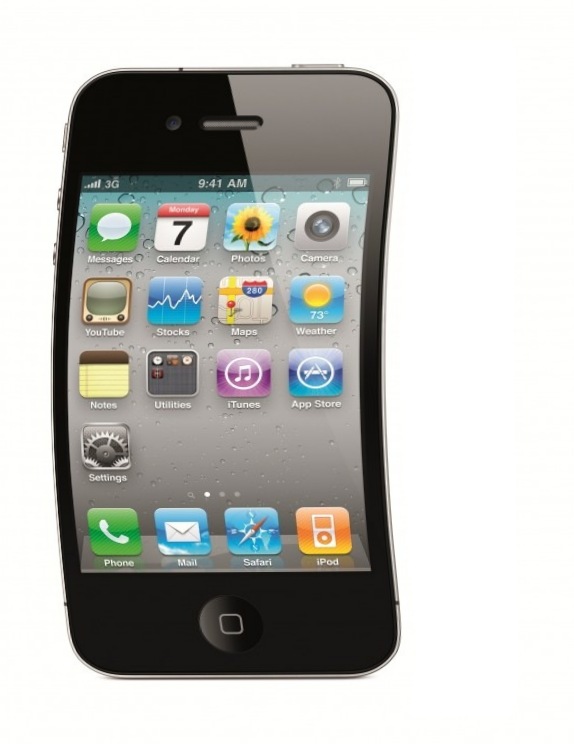







 Are fanbois ready for a new look for iPhones and iPads? Will a curvy iPhone have the same appeal?
According to AppleInsider, Apple has been granted a patent for a “Curved touch sensor,” a technology that describes “depositing and patterning a conductive thin film on a flexible substrate to form at least one touch sensor pattern, while the flexible substrate is in a flat state.”
U.S. Patent No. 8,603,574 also states that the method can support flexible materials placed on a material with a predetermined curvature, and is able to support accurate touch surfaces without causing deficiencies because of the wrapped or curved nature of the surface.
The patent states that the technology can be used in touch displays, touch pads, touch mice, and other devices.
Curved screens aren’t entirely new, but what makes Apple’s different from those that’re available now is the technique it uses makes for a more accurate and sensitive touch screen. The patent describes using two curved surfaces for the anneal process where the flexible substrate will be sandwiched and when heat is applied, the flexible substrate will be curved. This results ina uniform distance from the finger to the touch sensor, compared to using a flat substrate with a curved screen.
Two OEMs have already unveiled designs for curved phones, LG and its G Flex, and Samsung with its Galaxy Round phone. Both devices are curved in different manners for different functionalities. The Galaxy Round’s curved design introduces a new feature called “Round Interaction,” which means that when the device is place on a flat surface, tilting it to one side would allow the user to see information such as missed calls, battery life, and the date and time, even when the screen is turned off.
As for the G Flex, its curvature makes it more comfortable to hold when making a call, offers a more immersive video experience, and a brighter and more precise display thanks to its “Real RGB” pixel configuration. What makes it unique is its “swing lock screen” which moves the wallpaper in response to the tilting motion and produces different unlocking effects when the user touches different areas of the screen.
So how will Apple apply its curved touch sensor?
The first thing that comes to mind is of course the iWatch. All of the Smartwatches we’ve seen so far have really small screens, which limits the things you can do on the device. If Apple manages to create a smartwatch that has a slightly larger screen, like a wraparound iPhone for your wrist, and can make it function like a smartphone and not just an accessory for smartphones, Apple could dominate the wearable tech market.
This could also lead to a new design for iDevices and even Macs and other Apple accessories that utilize touch sensors. Some people are getting bored with how Apple’s products look, and so a curvier appearance may prevent fanbois from straying and could possibly entice non-Apple users to jump ship too.
Support our mission to keep content open and free by engaging with theCUBE community. Join theCUBE’s Alumni Trust Network, where technology leaders connect, share intelligence and create opportunities.
Founded by tech visionaries John Furrier and Dave Vellante, SiliconANGLE Media has built a dynamic ecosystem of industry-leading digital media brands that reach 15+ million elite tech professionals. Our new proprietary theCUBE AI Video Cloud is breaking ground in audience interaction, leveraging theCUBEai.com neural network to help technology companies make data-driven decisions and stay at the forefront of industry conversations.





