







This week’s SmartCar roundup features an app that connects your car to your home, a milestone for the youngest car manufacturer in the US, and a long term plan by Ford that demonstrates what happens when cars talk to each other.

Livio Connect, formerly known as Livio Radio, makes it easier for people to enable existing devices and apps communicate with one another. Livio Connect turns your car radio into a control center for all you connected home devices, as well as apps on mobile devices. It’s a protocol that enables users to control apps with their voice or fingers through the physical buttons on hardware equipment, such as enabled head units and consumer electronics.
The Livio Connect protocol is installed on hardware devices to send and receive information about app controls, and can also be added to third-party apps to facilitate communication between connected devices. For the security side, the apps receive an unlock key through Livio’s authentication server.
Tesla Motors is considerably younger than other established car manufacturers, but has managed to make a name for itself with its promise of cleaner air with its electric vehicles. A survey conducted by Consumer Reports puts Tesla’s Model S vehicle in fifth place of the survey, a huge step up from its 11th place positioning last year.
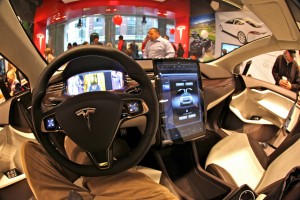 “Consumers are influenced by word of mouth, marketing and hands-on experience,” Jeff Bartlett, Consumer Reports deputy automotive editor, said in a statement. “Perception can be a trailing indicator, reflecting years of good or bad performance in a category, and it can also be influenced by headlines in the media.”
Tesla’s shares have significantly increased when the company reported its first quarterly profit back in May of last year, and it didn’t hurt that Consumer Reports gave the car the highest score compared to other cars that have been reviewed. Tesla’s shares rose by 0.9 percent to US$178.73 in the NYSE, tripling its value from before the Consumer Reports review was released last year.
The National Highway Traffic and Safety Administration may be wary about connected cars because of the dangers it poses for drivers, but there’s one technology that it is open to and hoping to roll out as soon as possible: vehicle-to-vehicle or V2V communication.
 The technology allows for vehicles to communicate with one another so they can get out of the way in case one vehicle is running amok. It will go like this, one vehicle might say, “Dude, get out of my way, I’m running that red light;” or another vehicle says “Stop! we just hit the car in front of us!”
Of course the vehicles won’t actually talk, they would have their conversations wirelessly and apply appropriate actions, such as stopping the car at a safe distance, or quickly changing lanes to avoid getting hit.
Ford has demonstrated its V2V technology in a closed course and showed how it can be used to prevent accordion crashes or crashes that include multiple vehicles slamming into one another because they weren’t aware that the car in front has stopped. The technology can also be used to avoid collisions in narrow roads, like those with blind curves, as it will get alerted if there’s an on coming vehicle. The technology doesn’t use cameras and lasers, but wireless communication and GPS as well as an alarm and lights to warn you of potential danger.
The system is far from being perfect and there are still a lot of things to consider but if perfected, the system has the potential to solve traffic jams and fatal road collisions.
Support our mission to keep content open and free by engaging with theCUBE community. Join theCUBE’s Alumni Trust Network, where technology leaders connect, share intelligence and create opportunities.
Founded by tech visionaries John Furrier and Dave Vellante, SiliconANGLE Media has built a dynamic ecosystem of industry-leading digital media brands that reach 15+ million elite tech professionals. Our new proprietary theCUBE AI Video Cloud is breaking ground in audience interaction, leveraging theCUBEai.com neural network to help technology companies make data-driven decisions and stay at the forefront of industry conversations.




